James Caldwell seemed to have everything: wealth, status, and a sprawling estate tucked into the gentle hills that ring the outskirts of Cambridge. He had founded one of the most triumphant cybersecurity firms in the UKs tech corridor and spent nearly two decades building his kingdom. Yet, despite his triumphs, a hollow echoed through his grand manor, a void that even the finest vintage or the most expensive sculpture could not fill.
Each morning James took the same route to his office, winding through the ancient quarter of the city. Lately, a ragtag group of homeless children had begun to gather outside a corner bakery that displayed framed photographs of local weddings in its window. One picturehis own wedding, taken ten years earlierhung proudly in the upperright corner of the glass. The photo had been taken by the bakers sister, an amateur photographer, and James had allowed it to stay because it captured the happiest day of his life.
But that happiness cracked. Six months after the ceremony his wife, Cressida, vanished without a trace. No ransom note, no clues. The police labelled the disappearance suspicious, but with no evidence the case was filed away. James never remarried. He drowned himself in work, constructing a digitally impregnable world, yet his heart lingered on the unanswered question: what had become of Cressida?
One rainy Thursday morning, James was driving to a board meeting when traffic stalled near the bakery. He glanced through the tinted windshield and saw a barefoot boy, no older than ten, drenched by the drizzle, staring intently at the wedding photograph in the shops display. James watched him without much thought until the boy pointed directly at the picture and told the shopkeeper, Thats my mum.
James felt his breath seize.
He rolled his window down halfway. The child was thin, his dark hair tangled, his shirt three sizes too big. James studied his face, a knot tightening in his gut. The boys eyes mirrored Cressidas: soft hazel flecked with green.
Hey, lad, James called out, voice a little louder than intended. What did you just say?
The boy turned, blinked, and repeated, Thats my mum, pointing again at the photograph. She used to sing to me at night. I remember her voice. One day, she just disappeared.
James abandoned the car, ignoring the drivers protests. Whats your name, son?
Oliver, the boy replied, trembling.
Oliver, James knelt to meet his height. Where do you live?
The boy lowered his gaze. Nowhere, really. Sometimes under a bridge. Sometimes by the railway line.
Do you remember anything else about your mum? James asked, trying to steady his voice.
She liked roses, Oliver said. And she wore a little necklace with a white stone, like a pearl.
Jamess heart clenched. Cressida had always worn a single pearl pendant, a gift from her motheran unmistakable heirloom.
Oliver, do you know your father? James asked slowly.
The boy shook his head. I never met him.
At that moment the bakery owner, a stout woman named Martha, emerged, curious about the commotion. James turned to her. Have you seen this boy before?
She nodded. Hes a regular. He never asks for money. He just stands and looks at that picture.
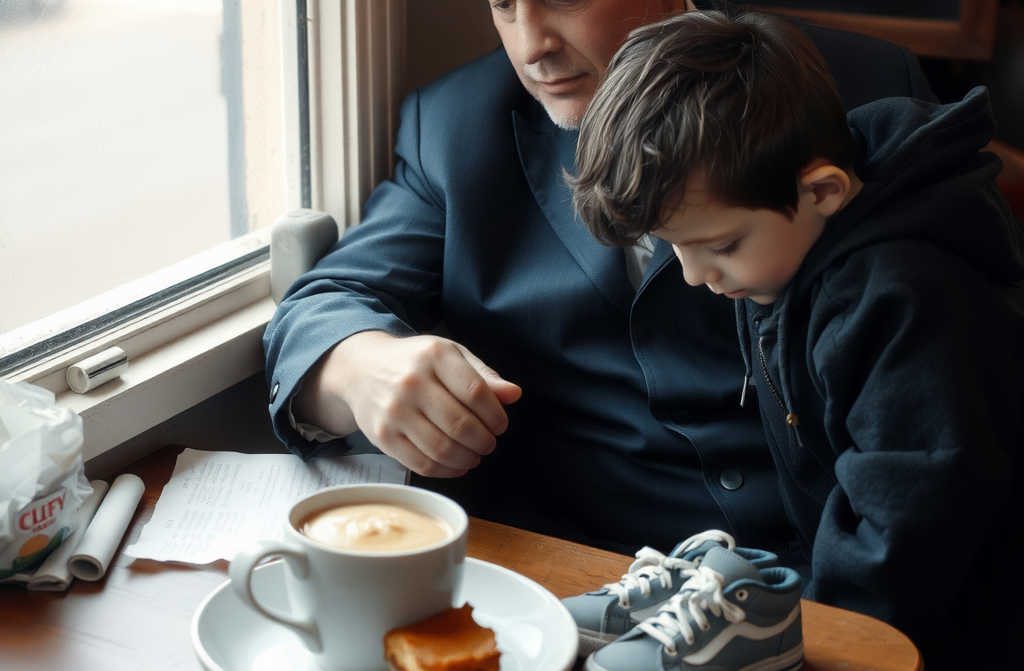
James called his assistant, cancelled the meeting, and took Oliver to a nearby café for a hot meal. Over the modest lunch he peppered the boy with more questions. Olivers recollections were fragmentary: a woman singing, a flat with green walls, a stuffed bear named Max. James sat there, stunned, as if fate had slipped a missing puzzle piece into his hands.
An DNA test would soon confirm what his intuition already whispered.
But before the results arrived, a question kept James awake that night:
If this boy is his, where had Cressida been for ten years? Why hadnt she ever returned?
The DNA report came three days later. The result struck James like a bolt of lightning.
Match: 99.9% James Caldwell is the biological father of Oliver Evans.
James sat in stunned silence as his assistant placed the file on the table. The ragged, silent boy who had pointed at a wedding photograph in a bakery window was his son, a son he never knew existed.
How could Cressida have been pregnant? She had never mentioned it. Yet she disappeared only six months after the wedding. Perhaps she never got the chance to tell him, or perhaps someone silenced her before she could.
James hired a private investigator. With his resources, the search was swift. A retired detective named Allen Briggs, who had once worked the original missingperson case, was brought back. He was wary of James, but the boy and the new evidence intrigued him.
The trail on Cressida went cold back then, Briggs said. But a childs mention changes everything. If someone was trying to protect a baby, it could explain her disappearance.
Within a week Briggs uncovered a twist James had never imagined.
Cressida had not vanished completely. Under the alias Marie Evans, she had been sighted in a womens shelter two villages away eight years earlier. Records were vague, likely for privacy, but one file stood out: a photograph of a woman with hazelgreen eyes cradling a newborn. The babys name? Oliver.
Briggs traced her next whereabouts to a small medical clinic in Devon. She had registered for prenatal care under a false name, left halfway through treatment, and never returned. From there she disappeared again.
Jamess pulse quickened as the clues piled up. She had been on the run. From whom?
The breakthrough came from a sealed police report mentioning a name hidden in the margins: Derrick Blake, Cressidas exboyfriend. James remembered him faintly; he had never met him, but Cressida once described Derrick as controlling and manipulative, someone she had broken off with before they met. What James didnt know was that Derrick had been released on parole three months before Cressida vanished.
Briggs uncovered court documents showing Cressida had filed an injunction against Derrick just two weeks before her disappearance, but the paperwork never reached the authorities. No protection was arranged.
A theory formed quickly: Derrick tracked down Cressida, threatenedor perhaps assaultedher, and fearing for his unborn child he fled, assuming a new identity. But why was Oliver out on the streets?
Another turn: two years prior, Cressida had been declared legally dead. A body had been found in a nearby estuary, its clothing matching what she wore on the day she vanished, and the police closed the case. Dental records, however, had never been crosschecked; the corpse was not her.
Briggs located the woman who ran the shelter where Cressida had stayed eight years earlier. Her name was Carla, now elderly, and she confirmed Jamess worst fear.
Cressida arrived terrified, absolutely terrified, Carla recalled. She said a man was after her. I helped her bring Oliver into the world. One night she vanished. I think someone found her.
James could hardly speak.
Then the phone rang.
A woman who looked exactly like Cressida had been arrested in Bristol for shoplifting. When her fingerprints were run through the database, an alert triggered the tenyearold missingperson case.
James boarded a flight that night.
In the detention centre, he stared through the glass at a pale woman with haunted eyes. She seemed older, gaunter, yet unmistakably Cressida.
Cressida, he whispered, his hand trembling as he reached for the pane, tears streaming down his cheeks.
I thought you were dead, James murmured.
I had to protect him, she replied, voice breaking. Derrick found me. I ran. I didnt know what else to do.
James brought her home, cleared the charges, arranged therapy, and most importantly, reunited her with Oliver.
The first time Oliver saw his mother again, he said nothing. He simply crossed the room and hugged her tightly.
Cressida, after a decade of hiding, fearing, fleeing, collapsed into her sons arms and wept.
James formally adopted Oliver. He, Cressida, and Oliver moved forward slowly, rebuilding trust and healing the wounds of trauma. Cressida testified against Derrick, who was later arrested on separate domesticviolence charges, and the old case was reopened, finally delivering justice.
James still glances at that wedding photograph in the bakery window. Once it had symbolised loss; now it stands as a testament to love, survival, and the strange, miraculous way destiny can stitch a shattered family back together.