
Nothing had truly changed…
Emily nervously twisted the edge of her sleeve, staring out the taxi window as familiar streets from childhood blurred pastthe very ones she once raced along with Oliver, their laughter ringing out while they spun plans for the years to come. Seven years. A full seven years since she had last returned to her hometown of York.
“We’re here,” the driver’s voice cut in softly, drawing her from her thoughts.
The taxi eased to a halt outside the entrance of an old five-storey building. Emily’s hand moved on its own to check her phone, then she pulled out some pound notes, paid the fare, and stepped onto the pavement. The door slammed shut, and she stood frozen for a moment, breathing in the air of York. It was different, undeniablynot like the sprawling metropolis of London where she lived now. Every scent, every faint sound here stirred something deep inside her. Freshly mown grass drifted from the nearby square, laced with the warm aroma of baked bread from the corner bakery, and something else, indescribable, that could only be called home. The mix clenched her heartpainfully sweet, as if joy and dread warred within her over what lay ahead.
She had come for just a few days. Officially to visit her mother and help with documents long overdue for attention. She also wanted to wander the old places, as if testing whether they still matched her memories. But deep in her soul another reason lingeredperhaps the real one. She ached to see Oliver! And who knew, perhaps her life would shift because of it?
Emily knew he lived nearby. Not that she had deliberately followed his lifeno, she had never asked about him outright. But friends, in passing meetings or online chats, sometimes let his name slip. From those fragments she gathered bits: he had changed jobs and now held a solid position, bought a flat, moved his mother in with him. Each mention sent her mind racing with images of him nowhow he looked, what filled his days, what crossed his thoughts. But she pushed them away at once, afraid to let them take root in her heart…
The next day Emily decided to walk through York’s city centre. No firm plansjust to breathe the urban air, see the familiar spots in daylight, feel the rhythm of streets that had once been part of her life. She moved slowly, peering into shop windows, a faint smile crossing her lips as long-forgotten things surfaced: the news kiosk where she bought comics, the bench where she and her friends sat after school, the cafe where she first tried a cappuccino and nearly spilled it on her new blouse.
And then she saw him.
Oliver walked along the opposite side of the street. He hadn’t noticed hergaze fixed ahead, head slightly tilted as if lost in thought. Emily froze. Everything inside lurched so violently that for an instant she forgot how to breathe. He looked unchangedstill tall, with that same easy, relaxed stride from their youth. The same silhouette, the same movements, even the same haircut.
Without thinking she darted across the road. The lights flashed amber, a sharp horn blared somewhere, but she barely heard it. Her legs carried her forward on their own, her heart pounding so hard it seemed the whole street could hear.
“Oliver!” she called as she caught up with him outside the shop.
Her voice trembledshe hadn’t realised she was this nervous. He turned, and… nothing. No joy in his eyes, no anger. Nothing at all.
“Emily?” he said calmly, almost with detachment.
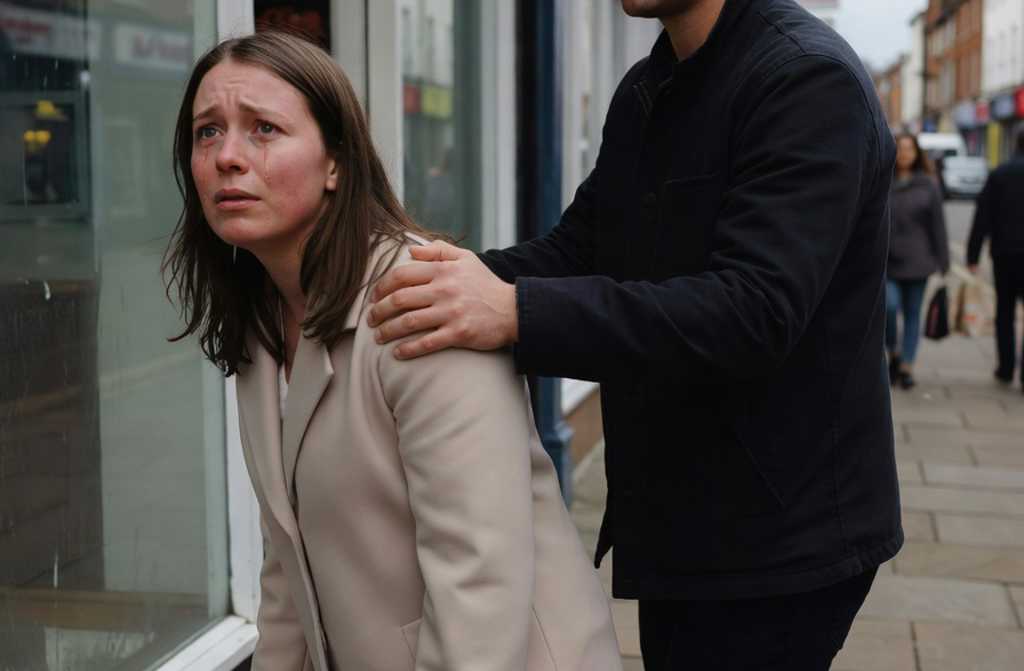
That toneso even, stripped of feelingstruck harder than she had braced for. Everything built up over seven years suddenly burst free. Tears filled her eyes, her voice shook, and she could not stop.
“Oliver, I… I’m so sorry,” she managed, words coming with effort. “I know I have no right to approach you, but I…” She sobbed, tried to steady herself, yet the tears streamed down her cheeks unchecked. “I love you. I still love you. Forgive me. Please, forgive me!”
She spoke quickly, in fragments, as if pausing would silence her forever. Her mind churned with explanations and pleas, yet only the core truths escapedthe ones she had held inside for so long.
She wrapped her arms around him, pressing tightly to his chest, as though the embrace could reclaim what had been lost seven years before. In that moment the noisy street, the passers-by, time itself vanishedonly the warmth of his body and her desperate hope that he might return the hug remained.
Oliver did not pull away at once. For a split second she sensed a hesitationhis shoulders lowered a fraction, his hands rose almost imperceptibly, as if he too longed to hold her in return. That fleeting flicker lit a spark of hope: perhaps it was not too late, perhaps he had kept those memories too… Maybe they still had a future!
But the instant faded. Oliver grasped her shoulders firmly and eased her away with gentle yet unyielding force. His face stayed calm, nearly impassive, his gaze hard and cold. These were not the eyes of the boy she had once laughed with until tears came and dreamed of a shared tomorrow. Before her stood a grown man whose feelings had long been locked behind an unyielding wall.
“Leave,” he murmured close to her ear.
He said it softly and without emotion, as if she meant nothing to him at all. As if she were a stranger, unworthy of his notice.
“I hate you,” he added a moment later, and now undisguised contempt flashed in his stare.
He turned and walked away without looking back. Emily stood rooted, stunned. Life continued around her: people hurried on errands, cars honked at the crossroads, children’s laughter echoed in the distance. A passer-by glanced sideways at her, perhaps wondering why the girl stood motionless in the street with a frozen gaze and pale face. But she noticed none of it.
Only the fading sound of his footsteps and her own ragged, faltering breaths. Every second stretched into eternity, one thought looping: “This is the end. Forever.”
She trudged home slowly. Her legs felt leaden, every step an effort, yet she pressed on, gaze blank ahead. Her mind was emptyno thoughts, no feelings, only the hollow echo of his words pounding inside.
When Emily entered her mother’s flat she offered no explanation. Silently she went into the room, sank onto a chair, and stared out the window. Her mother saw the tear-streaked face and extinguished eyes but asked nothing. She sighed quietly, as though she had long expected this moment, and went to put on the kettle. The familiar sound of boiling water, the scent of brewed teaall so ordinary against the turmoil inside Emily. Yet this very simplicity helped draw her back to reality.
“He didn’t forgive me,” Emily whispered, clutching a cup of hot tea. The steam warmed her face faintly, but she barely noticed. Her fingers tightened around the cup, as if trying to hold something slipping away, her eyes fixed on the golden liquid where lamplight glinted dully.
Her mother sat beside her without a word, resting a hand on her shoulder. The touch was tender and familiarlike when Emily was a child coming home with a scraped knee or after a quarrel with a friend. This simple gesture made her feel small and vulnerable again, as if all the grown-up choices of recent years had melted without trace.
“You knew it would be like this,” her mother said softly, no reproach, only quiet sadness.
“I did,” Emily nodded, finally lifting her gaze from the cup. Her voice sounded steady but weary, as if she had rehearsed this admission for years. “But I hoped. Foolish, isn’t it?”
“Not foolish,” her mother countered gently. “You simply chose your path. You hurt Oliver deeply; he couldn’t recover from the breakup for a long time… He seemed to have turned into a man whose heart had frozen solid, like in the old children’s tales. No one could touch it anymore.”
Emily sighed deeply, set the cup aside and leaned back. Memories from seven years ago rose unbidden.
Back then everything had seemed simple. She was twenty-two, an age when the future blazed with promise and obstacles felt surmountable. Oliver was therekind, dependable, the one she could rely on through anything. He was not one for eloquent speeches about feelings, but his actions spoke louder: always ready to help, a good listener, supportive even in small ways.
Yet one problem loomedor what she then saw as a problem. Oliver worked on construction sites, studied part-time, dreamed of starting his own business. His plans were solid and thoughtful but needed timetime she was unwilling to give.
She did not crave wealth. She wanted stability, certainty about tomorrow. To know that in a year, two, five she would have work, a home, the freedom to shape her life. With Oliver it all felt too uncertain: endless odd jobs, evening classes, dreams that stayed just that.
When her uncle from London offered her a job in his firm she accepted without hesitation. It was a real chance, tangible, not to be missed.
There was morea truth she tried to bury. Around the time she moved to London and began working, Richard entered her life. He was a wealthy businessman, twice her age, with assured manners and a habit of getting what he wanted. Their meeting was chanceat a work event where Emily felt out of place in her new dress among polished colleagues. Richard noticed her at once: sat down, struck up conversation, asked about her job, plans, life.
He was generous with attention. First flowersnot lavish roses, but neat bouquets delivered to the office with notes: “For the most beautiful.” Then invitations to restaurants she had only admired from outside. He took her to exhibitions, theatres, gave gifts she had never dared dream of: silk scarves, delicate jewellery, heels with slender straps. Each came with words about how she deserved the best life, how she should not limit herself, how important it was to seize what fate offered.
At first Emily resistedembarrassed, declining, explaining she needed no such things. But Richard persisted gently, insisting it was merely admiration, that he truly appreciated her mind and beauty. Gradually she accepted his attentions. The glittering new world pulled her in: evenings in elegant restaurants, rides in upscale taxis, the freedom to buy whatever caught her eye without checking the price. It felt like a magical dream she did not want to end.
Somewhere amid those dazzling moments she began seeing Richard. Not from burning passion, but because his world beckoned with its ease and security. With him she did not have to worry about tomorrow, wonder if there would be enough for rent or a new outfit for an important meeting. He took care of everything, wrapping her in a cocoon of carefreeness.
And she loved this life. So much that thoughts of the heartbroken young man back home faded. Worseshe began to look down on him, declaring that Oliver would never amount to anything.
One day Emily returned to York. Not to see Oliver, not to clear the air or even say hello. She wanted to flaunt her new life, show him what she was truly “worthy” of. Deep inside a thought smouldered: let him see she had not erred, that her choice was right, that she had escaped the uncertainty of their relationship.
She planned the visit carefully. Chose a cafe on the main streetthe one Oliver sometimes visited for coffee after work. Wore an expensive dress Richard had given her for her birthdayelegant, with a slim belt accentuating her waist. A ring with a large stone sparkled on her fingeranother gift. She carried a bag from the latest collection, bought the day before after spotting it in a window.
When Oliver entered the cafe Emily noticed him at once. She sat by the window, laughing loudly at something her companion said, and turned so Oliver would surely see her. Their eyes met. In his she read confusion, pain, bewildermentall she had been ignoring in herself for months. But instead of looking away embarrassed she held his gaze steady.
In that instant it felt like victory. She had proven to herself and him that she had chosen correctly. Her life was now not endless talks of tomorrow but real chances, luxury and confidence. She convinced herself she felt satisfied, that she had finally got what she deserved.
But when Oliver left the cafe and she remained at the table her laughter gradually died. She looked at the ring, the bag, her companion still talking, and felt a strange emptiness. All of itthe costly items, the charming gestures, the attentionsuddenly seemed distant and unreal. Though she kept smiling and chatting, something inside whispered: “Was it worth it?”
The victory turned bitterEmily realised this not at once, but day by day the understanding grew clearer. At first Richard kept his image as a generous, attentive man: dinners out, flowers, compliments. But over time his interest waned, like a candle burning low on wax.
It began with small things. Warm words gave way to curt remarks. Unexpected gifts to brief texts: “Pop into that shop, pick something yourself.” Then came sharper jabs. He began criticising her appearance: “Maybe you should take more care with how you look?”, her way of speaking: “Why do you laugh so loudly? It’s vulgar”, her occasional friends: “Those provincial acquaintances again? Don’t you think it’s time for a more interesting circle?”
His presence grew rarer. He would vanish for days, sometimes weeks, leaving her alone in the spacious flat he had rented. Emily spent evenings by herself, listening to the ticking clock or idly sorting through wardrobe items. When she tried to talk, to say she missed their connection, he brushed it off, avoiding her eyes:
“You got what you wanted. What more do you need?”
Emily searched for excuses for his behaviour. “His business is demanding,” she thought, “probably a lot of stress.” Or: “He’s just tired, needs space.” She told herself these were temporary hurdles, that things would improve, that she was too demanding. But deep down she knew: it was not fatigue or work. She had become another pretty toy for himshiny, new, attention-grabbing. Once the novelty wore off, the interest faded.
She endured. Endured his cutting words, his icy silences, his long absences. Endured because she feared admitting one crucial truth: she had been wrong. Admitting the glittering life was hollow would mean admitting she had betrayed the only man who had loved her truly. That Oliver, with his modest job and dreams of his own venture, was the one who valued her for who she was, not for the shine or fitting someone’s idea of a perfect partner.
Eventually even the trappings of luxury brought no joy. Expensive dresses she once admired hung lifeless in the wardrobe. Jewellery that once thrilled lay in its box like strangers. The restaurants she had loved at firstwith their soft lighting, fine dishes, festive airnow irritated just by their sight. The scent of costly perfume, once a symbol of her new life, now turned her stomach slightly.
She caught herself more often staring out the window at passers-by, thinking: “What if…” But she cut the thoughts short, afraid to let them loose. Because they led to a question with no answer: “What next?”
In those lonely evenings, as dusk thickened outside and the flat filled with near-deafening silence, Emily pondered how her dreams of stability had proven empty. She imagined a life with certainty about tomorrow, no money worries, everything planned and ordered. But now, in that spacious, well-furnished flat, she saw clearly: without someone to share that stability with, it all meant nothing.
Her thoughts returned to Oliver. She remembered his handsstrong, a bit rough from work, yet so warm when he took her palms in his. His smilenot flashy, but quiet and genuine, appearing when he was truly happy. How he spoke of the future: no grandstanding or big promises, just sharing plans, believing they would succeed. And that belief felt so real, so solid, that Emily had felt she could face anything with him…
On the third day back home Emily decided to walk in the park where they used to stroll together. There was the bench under the spreading maplethey often sat here, chatting about everything, laughing at trifles. Emily recalled how Oliver, watching falling leaves, had said: “You know, I want us to have our own house. With big windows so the morning sun pours right into the room. And always full of light and happiness.” She had just smiled then, thinking it mere dreams. Now the words echoed differentlylike something missed, lost.
She stopped, breathed the cool air, trying to gather her thoughts. And at that moment heard a familiar voice:
“Emily?”
She turned. Before her stood Arthurtheir mutual friend with Oliver. He looked surprised but smiled quickly, glad to see her.
“Didn’t expect to find you here,” he said, raising his eyebrows slightly. “How are you?”
Emily hesitated a moment, choosing words. She wanted to answer lightly, casually, but her voice wavered despite her efforts to hide it.
“Fine,” she tried to smile, and it came out less forced than feared. “Came to visit Mum.”
Arthur nodded, giving her a careful look, but did not press further. Instead he gestured to a nearby bench:
“Want to sit? I was just walking, wondering where to go next.”
Emily agreed, and they walked slowly to the bench. Along the way Arthur talked about how things were going for him, what was new in York lately. His voice was calm, friendly, and it eased Emily a bit. She listened, chimed in briefly now and then, all while thinking how odd it was: back in her hometown where every corner stirred the past, and already running into someone from that life.
Arthur nodded, paused as if selecting words, then asked calmly, without pressure:
“Have you seen Oliver?”
Emily’s eyes dropped involuntarily, her gaze sliding over the fallen leaves at her feet. She did not answer right awaymemories of yesterday’s encounter flashed: his cold look, the short, wounding words. Finally she said softly:
“Yes. Yesterday.”
“And how did it go?” Arthur asked, watching her closely.
“He… he doesn’t want to know me,” Emily exhaled, each word a struggle. Her voice was level but heavy with suppressed emotion, as if holding back a storm inside. “He hates me.”
Arthur sighed, sat on the bench beside her, rested his elbows on his knees and gazed into the distance where the park path faded into the golden autumn haze. He was silent for several seconds, weighing his response, then spoke quietly:
“You know, he took a long time to get over it. You just vanished, Emily. No call, no letter. For him it was like a knife in the back.”
Emily clenched her fingers, feeling everything tighten inside. She knew this, understood it, but hearing it confirmed by another made it harder than expected.
“I know,” she whispered, not raising her eyes. “It’s my fault.”
Arthur turned his head slightly toward her but did not push or lecture. Instead he continued evenly:
“He tried to forget you. Dated others, but nothing worked. Says he can’t love anyone like he loved you. He was in a bad way, you know? And after your showy appearance… I thought he’d shut himself off completely!”
Emily nodded silently. She pictured Oliver struggling to move on, forcing himself not to think of her, probably startling at similar voices or stray memories. And that made it hurt morenot just his suffering, but that she had caused it.
“I didn’t know it would be like this,” she said quietly, more to herself than Arthur. “I thought I was making the right choice. I wanted stability.”
Arthur did not argue or try to convince her otherwise. He simply sat with her, giving her time to absorb it. Wind rustled through the park, leaves spiralled in a slow dance, and children laughed somewhere by the fountain. Life carried on.
Emily balled her fists so tight her nails bit into her palms. She fought to hold back tears, but they welled anyway, blurring her vision. Everything inside contracted with bitter realisation: she could not fix it, could not turn back time, could not undo what she had done.
“I’m not asking him to forgive me,” she said in a shaky voice, struggling for words. “I just wanted him to knowI’m sorry! I regret what I did every single day. These thoughts won’t leave me alone! I keep remembering how it was… and how I destroyed it all.”
Arthur looked at her intently, without judgment. He did not rush his replyit was clear he was measuring each word.
“Maybe he doesn’t need to know,” he finally said quietly but firmly. “Leave him be, don’t come back, you’re only making it worse. It took him a long time to recover after you left. And he’s probably learned to cope somehow. But your showing up… it’s stirred everything up again! He called me yesterday and… he was drunk out of his mind. I haven’t seen him like that in ages, you know? Don’t ruin his life, Emily.”
The girl bit her lip hard but stayed silent. She understood Arthur was right. Her sudden return, the attempt to see Oliverit had only reopened old wounds he had tried to heal over the years. She had wanted to make amends, but perhaps had only inflicted new pain…
That evening Emily sat by the window in her mother’s flat. Outside, York’s lights were slowly coming onyellow, orange, whiteblending into a whimsical mosaic, shimmering and changing, creating an illusion of celebration. But she had no mind for the beauty of the evening streets. Thoughts whirled in her headone after another, like frames from an old film she could not pause.
She imagined how it all could have been if she had stayed then. How they would have rented their first flat together, how Oliver would have built his business, how they would have planned the future, laughed at small troubles, celebrated tiny victories. She thought of all the happy moments missed, all the warm words unsaid, all the touches not shared. But the past could not be changedshe understood that with a clarity sharper than ever.
The next day Emily left. She packed her things slowly, without haste, as if wanting to delay the farewell. Her mother stood in the doorway, watching silently, and in her eyes was a quiet sadnessnot reproach, but simple sorrow that her daughter was leaving again.
“Take care of yourself,” her mother said as Emily stood in the hallway, suitcase in hand.
Emily nodded, kissed her on the cheek, lingered a moment breathing in the familiar scent of home, then stepped out onto the street.
At the station she bought a ticket to Londonshe needed to think. A couple of days on the train, among strangers… Maybe it would help her figure out how to go on.
The train pulled away smoothly, swaying gently on the tracks. Emily kept her eyes on the window. Outside, the familiar outlines of York slid by: five-storey buildings with balconies adorned with flowers, a children’s playground where she once played with friends, a small bakery with a bright sign. People hurried about their dayssome with shopping bags, some with umbrellas open despite clear skies, some rushing to the bus stop. It was all so ordinary, so familiar, yet now felt endlessly distant.
Somewhere among these streets and homes remained the man she loved more than anything. The man whose eyes lit up when he spoke of the future, whose hands could do heavy labour and hold her palm tenderly. The man to whom she had not found time to explain her departure, had not given a chance to say goodbye. And now he was lost to her forevershe understood that clearly, no matter how she tried to convince herself it was not over…
Six months passed. Emily continued living in London, going to work, meeting friends for coffee on weekends, answering questions about how she was and her plans. On the surface everything looked the same as before: the same routine, the same places, the same conversations. But inside something had irreversibly shifted. She no longer ran from the past, did not try to bury it under new acquaintances, expensive buys or a packed schedule. Now she faced it head-on, without fear: accepted her mistake, acknowledged the pain she had caused, and her genuine remorse.
She had learned to wake with the thought that life goes on. Learned to tell herself: “I did what I did. It was wrong, but nothing can change it now.” And in this acceptance was a strange, quiet reliefnot happiness, no, but at least the ability to breathe easier, to look forward without panic.
One evening, while Emily was preparing dinner, her phone beeped softly with a new message. She wiped her hands on a towel, picked up the smartphone and saw an unknown number. Just one sentence on the screen: “I don’t hate you. But I can’t forgive you either.”
Emily froze. Her fingers tightened around the phone on their own, and her heart seemed to stop for a second, then raced faster. She slowly sank to the floor, pressing the smartphone to her chest, as if trying to feel through it the beat of another heartthe one belonging to the man who had written those words.
She did not know what it meant. Did not understand how to interpret the lineswhether a step toward her or a final “goodbye.” But for the first time in a long while it seemed there was still some thread between them. Thin, fragile, ready to snap at the slightest wrong move, but stilla connection. Someone out there, in another city, was thinking of her. Someone had decided to write, despite the pain and resentment. Someone had not shut the door completely.
Emily smiled through her tears. The smile was hesitant, uncertain, but real. Maybe this was not the end. Maybe someday they could talkcalmly, without accusations, without trying to justify themselves or the other. Maybe they would find words to help them both move forwardtogether or apart, but with clear understanding.
For now… for now, it was enough to know that he still thought of her. That somewhere there, hundreds of miles away, lived a man who remembered her not only as a mistake from the past, but as part of his story.
And thatfor nowwas enough.Nothing had truly changed…
Emily nervously twisted the edge of her sleeve, staring out the taxi window as familiar streets from childhood blurred pastthe very ones she once raced along with Oliver, their laughter ringing out while they spun plans for the years to come. Seven years. A full seven years since she had last returned to her hometown of York.
“We’re here,” the driver’s voice cut in softly, drawing her from her thoughts.
The taxi eased to a halt outside the entrance of an old five-storey building. Emily’s hand moved on its own to check her phone, then she pulled out some pound notes, paid the fare, and stepped onto the pavement. The door slammed shut, and she stood frozen for a moment, breathing in the air of York. It was different, undeniablynot like the sprawling metropolis of London where she lived now. Every scent, every faint sound here stirred something deep inside her. Freshly mown grass drifted from the nearby square, laced with the warm aroma of baked bread from the corner bakery, and something else, indescribable, that could only be called home. The mix clenched her heartpainfully sweet, as if joy and dread warred within her over what lay ahead.
She had come for just a few days. Officially to visit her mother and help with documents long overdue for attention. She also wanted to wander the old places, as if testing whether they still matched her memories. But deep in her soul another reason lingeredperhaps the real one. She ached to see Oliver! And who knew, perhaps her life would shift because of it?
Emily knew he lived nearby. Not that she had deliberately followed his lifeno, she had never asked about him outright. But friends, in passing meetings or online chats, sometimes let his name slip. From those fragments she gathered bits: he had changed jobs and now held a solid position, bought a flat, moved his mother in with him. Each mention sent her mind racing with images of him nowhow he looked, what filled his days, what crossed his thoughts. But she pushed them away at once, afraid to let them take root in her heart…
The next day Emily decided to walk through York’s city centre. No firm plansjust to breathe the urban air, see the familiar spots in daylight, feel the rhythm of streets that had once been part of her life. She moved slowly, peering into shop windows, a faint smile crossing her lips as long-forgotten things surfaced: the news kiosk where she bought comics, the bench where she and her friends sat after school, the cafe where she first tried a cappuccino and nearly spilled it on her new blouse.
And then she saw him.
Oliver walked along the opposite side of the street. He hadn’t noticed hergaze fixed ahead, head slightly tilted as if lost in thought. Emily froze. Everything inside lurched so violently that for an instant she forgot how to breathe. He looked unchangedstill tall, with that same easy, relaxed stride from their youth. The same silhouette, the same movements, even the same haircut.
Without thinking she darted across the road. The lights flashed amber, a sharp horn blared somewhere, but she barely heard it. Her legs carried her forward on their own, her heart pounding so hard it seemed the whole street could hear.
“Oliver!” she called as she caught up with him outside the shop.
Her voice trembledshe hadn’t realised she was this nervous. He turned, and… nothing. No joy in his eyes, no anger. Nothing at all.
“Emily?” he said calmly, almost with detachment.
That toneso even, stripped of feelingstruck harder than she had braced for. Everything built up over seven years suddenly burst free. Tears filled her eyes, her voice shook, and she could not stop.
“Oliver, I… I’m so sorry,” she managed, words coming with effort. “I know I have no right to approach you, but I…” She sobbed, tried to steady herself, yet the tears streamed down her cheeks unchecked. “I love you. I still love you. Forgive me. Please, forgive me!”
She spoke quickly, in fragments, as if pausing would silence her forever. Her mind churned with explanations and pleas, yet only the core truths escapedthe ones she had held inside for so long.
She wrapped her arms around him, pressing tightly to his chest, as though the embrace could reclaim what had been lost seven years before. In that moment the noisy street, the passers-by, time itself vanishedonly the warmth of his body and her desperate hope that he might return the hug remained.
Oliver did not pull away at once. For a split second she sensed a hesitationhis shoulders lowered a fraction, his hands rose almost imperceptibly, as if he too longed to hold her in return. That fleeting flicker lit a spark of hope: perhaps it was not too late, perhaps he had kept those memories too… Maybe they still had a future!
But the instant faded. Oliver grasped her shoulders firmly and eased her away with gentle yet unyielding force. His face stayed calm, nearly impassive, his gaze hard and cold. These were not the eyes of the boy she had once laughed with until tears came and dreamed of a shared tomorrow. Before her stood a grown man whose feelings had long been locked behind an unyielding wall.
“Leave,” he murmured close to her ear.
He said it softly and without emotion, as if she meant nothing to him at all. As if she were a stranger, unworthy of his notice.
“I hate you,” he added a moment later, and now undisguised contempt flashed in his stare.
He turned and walked away without looking back. Emily stood rooted, stunned. Life continued around her: people hurried on errands, cars honked at the crossroads, children’s laughter echoed in the distance. A passer-by glanced sideways at her, perhaps wondering why the girl stood motionless in the street with a frozen gaze and pale face. But she noticed none of it.
Only the fading sound of his footsteps and her own ragged, faltering breaths. Every second stretched into eternity, one thought looping: “This is the end. Forever.”
She trudged home slowly. Her legs felt leaden, every step an effort, yet she pressed on, gaze blank ahead. Her mind was emptyno thoughts, no feelings, only the hollow echo of his words pounding inside.
When Emily entered her mother’s flat she offered no explanation. Silently she went into the room, sank onto a chair, and stared out the window. Her mother saw the tear-streaked face and extinguished eyes but asked nothing. She sighed quietly, as though she had long expected this moment, and went to put on the kettle. The familiar sound of boiling water, the scent of brewed teaall so ordinary against the turmoil inside Emily. Yet this very simplicity helped draw her back to reality.
“He didn’t forgive me,” Emily whispered, clutching a cup of hot tea. The steam warmed her face faintly, but she barely noticed. Her fingers tightened around the cup, as if trying to hold something slipping away, her eyes fixed on the golden liquid where lamplight glinted dully.
Her mother sat beside her without a word, resting a hand on her shoulder. The touch was tender and familiarlike when Emily was a child coming home with a scraped knee or after a quarrel with a friend. This simple gesture made her feel small and vulnerable again, as if all the grown-up choices of recent years had melted without trace.
“You knew it would be like this,” her mother said softly, no reproach, only quiet sadness.
“I did,” Emily nodded, finally lifting her gaze from the cup. Her voice sounded steady but weary, as if she had rehearsed this admission for years. “But I hoped. Foolish, isn’t it?”
“Not foolish,” her mother countered gently. “You simply chose your path. You hurt Oliver deeply; he couldn’t recover from the breakup for a long time… He seemed to have turned into a man whose heart had frozen solid, like in the old children’s tales. No one could touch it anymore.”
Emily sighed deeply, set the cup aside and leaned back. Memories from seven years ago rose unbidden.
Back then everything had seemed simple. She was twenty-two, an age when the future blazed with promise and obstacles felt surmountable. Oliver was therekind, dependable, the one she could rely on through anything. He was not one for eloquent speeches about feelings, but his actions spoke louder: always ready to help, a good listener, supportive even in small ways.
Yet one problem loomedor what she then saw as a problem. Oliver worked on construction sites, studied part-time, dreamed of starting his own business. His plans were solid and thoughtful but needed timetime she was unwilling to give.
She did not crave wealth. She wanted stability, certainty about tomorrow. To know that in a year, two, five she would have work, a home, the freedom to shape her life. With Oliver it all felt too uncertain: endless odd jobs, evening classes, dreams that stayed just that.
When her uncle from London offered her a job in his firm she accepted without hesitation. It was a real chance, tangible, not to be missed.
There was morea truth she tried to bury. Around the time she moved to London and began working, Richard entered her life. He was a wealthy businessman, twice her age, with assured manners and a habit of getting what he wanted. Their meeting was chanceat a work event where Emily felt out of place in her new dress among polished colleagues. Richard noticed her at once: sat down, struck up conversation, asked about her job, plans, life.
He was generous with attention. First flowersnot lavish roses, but neat bouquets delivered to the office with notes: “For the most beautiful.” Then invitations to restaurants she had only admired from outside. He took her to exhibitions, theatres, gave gifts she had never dared dream of: silk scarves, delicate jewellery, heels with slender straps. Each came with words about how she deserved the best life, how she should not limit herself, how important it was to seize what fate offered.
At first Emily resistedembarrassed, declining, explaining she needed no such things. But Richard persisted gently, insisting it was merely admiration, that he truly appreciated her mind and beauty. Gradually she accepted his attentions. The glittering new world pulled her in: evenings in elegant restaurants, rides in upscale taxis, the freedom to buy whatever caught her eye without checking the price. It felt like a magical dream she did not want to end.
Somewhere amid those dazzling moments she began seeing Richard. Not from burning passion, but because his world beckoned with its ease and security. With him she did not have to worry about tomorrow, wonder if there would be enough for rent or a new outfit for an important meeting. He took care of everything, wrapping her in a cocoon of carefreeness.
And she loved this life. So much that thoughts of the heartbroken young man back home faded. Worseshe began to look down on him, declaring that Oliver would never amount to anything.
One day Emily returned to York. Not to see Oliver, not to clear the air or even say hello. She wanted to flaunt her new life, show him what she was truly “worthy” of. Deep inside a thought smouldered: let him see she had not erred, that her choice was right, that she had escaped the uncertainty of their relationship.
She planned the visit carefully. Chose a cafe on the main streetthe one Oliver sometimes visited for coffee after work. Wore an expensive dress Richard had given her for her birthdayelegant, with a slim belt accentuating her waist. A ring with a large stone sparkled on her fingeranother gift. She carried a bag from the latest collection, bought the day before after spotting it in a window.
When Oliver entered the cafe Emily noticed him at once. She sat by the window, laughing loudly at something her companion said, and turned so Oliver would surely see her. Their eyes met. In his she read confusion, pain, bewildermentall she had been ignoring in herself for months. But instead of looking away embarrassed she held his gaze steady.
In that instant it felt like victory. She had proven to herself and him that she had chosen correctly. Her life was now not endless talks of tomorrow but real chances, luxury and confidence. She convinced herself she felt satisfied, that she had finally got what she deserved.
But when Oliver left the cafe and she remained at the table her laughter gradually died. She looked at the ring, the bag, her companion still talking, and felt a strange emptiness. All of itthe costly items, the charming gestures, the attentionsuddenly seemed distant and unreal. Though she kept smiling and chatting, something inside whispered: “Was it worth it?”
The victory turned bitterEmily realised this not at once, but day by day the understanding grew clearer. At first Richard kept his image as a generous, attentive man: dinners out, flowers, compliments. But over time his interest waned, like a candle burning low on wax.
It began with small things. Warm words gave way to curt remarks. Unexpected gifts to brief texts: “Pop into that shop, pick something yourself.” Then came sharper jabs. He began criticising her appearance: “Maybe you should take more care with how you look?”, her way of speaking: “Why do you laugh so loudly? It’s vulgar”, her occasional friends: “Those provincial acquaintances again? Don’t you think it’s time for a more interesting circle?”
His presence grew rarer. He would vanish for days, sometimes weeks, leaving her alone in the spacious flat he had rented. Emily spent evenings by herself, listening to the ticking clock or idly sorting through wardrobe items. When she tried to talk, to say she missed their connection, he brushed it off, avoiding her eyes:
“You got what you wanted. What more do you need?”
Emily searched for excuses for his behaviour. “His business is demanding,” she thought, “probably a lot of stress.” Or: “He’s just tired, needs space.” She told herself these were temporary hurdles, that things would improve, that she was too demanding. But deep down she knew: it was not fatigue or work. She had become another pretty toy for himshiny, new, attention-grabbing. Once the novelty wore off, the interest faded.
She endured. Endured his cutting words, his icy silences, his long absences. Endured because she feared admitting one crucial truth: she had been wrong. Admitting the glittering life was hollow would mean admitting she had betrayed the only man who had loved her truly. That Oliver, with his modest job and dreams of his own venture, was the one who valued her for who she was, not for the shine or fitting someone’s idea of a perfect partner.
Eventually even the trappings of luxury brought no joy. Expensive dresses she once admired hung lifeless in the wardrobe. Jewellery that once thrilled lay in its box like strangers. The restaurants she had loved at firstwith their soft lighting, fine dishes, festive airnow irritated just by their sight. The scent of costly perfume, once a symbol of her new life, now turned her stomach slightly.
She caught herself more often staring out the window at passers-by, thinking: “What if…” But she cut the thoughts short, afraid to let them loose. Because they led to a question with no answer: “What next?”
In those lonely evenings, as dusk thickened outside and the flat filled with near-deafening silence, Emily pondered how her dreams of stability had proven empty. She imagined a life with certainty about tomorrow, no money worries, everything planned and ordered. But now, in that spacious, well-furnished flat, she saw clearly: without someone to share that stability with, it all meant nothing.
Her thoughts returned to Oliver. She remembered his handsstrong, a bit rough from work, yet so warm when he took her palms in his. His smilenot flashy, but quiet and genuine, appearing when he was truly happy. How he spoke of the future: no grandstanding or big promises, just sharing plans, believing they would succeed. And that belief felt so real, so solid, that Emily had felt she could face anything with him…
On the third day back home Emily decided to walk in the park where they used to stroll together. There was the bench under the spreading maplethey often sat here, chatting about everything, laughing at trifles. Emily recalled how Oliver, watching falling leaves, had said: “You know, I want us to have our own house. With big windows so the morning sun pours right into the room. And always full of light and happiness.” She had just smiled then, thinking it mere dreams. Now the words echoed differentlylike something missed, lost.
She stopped, breathed the cool air, trying to gather her thoughts. And at that moment heard a familiar voice:
“Emily?”
She turned. Before her stood Arthurtheir mutual friend with Oliver. He looked surprised but smiled quickly, glad to see her.
“Didn’t expect to find you here,” he said, raising his eyebrows slightly. “How are you?”
Emily hesitated a moment, choosing words. She wanted to answer lightly, casually, but her voice wavered despite her efforts to hide it.
“Fine,” she tried to smile, and it came out less forced than feared. “Came to visit Mum.”
Arthur nodded, giving her a careful look, but did not press further. Instead he gestured to a nearby bench:
“Want to sit? I was just walking, wondering where to go next.”
Emily agreed, and they walked slowly to the bench. Along the way Arthur talked about how things were going for him, what was new in York lately. His voice was calm, friendly, and it eased Emily a bit. She listened, chimed in briefly now and then, all while thinking how odd it was: back in her hometown where every corner stirred the past, and already running into someone from that life.
Arthur nodded, paused as if selecting words, then asked calmly, without pressure:
“Have you seen Oliver?”
Emily’s eyes dropped involuntarily, her gaze sliding over the fallen leaves at her feet. She did not answer right awaymemories of yesterday’s encounter flashed: his cold look, the short, wounding words. Finally she said softly:
“Yes. Yesterday.”
“And how did it go?” Arthur asked, watching her closely.
“He… he doesn’t want to know me,” Emily exhaled, each word a struggle. Her voice was level but heavy with suppressed emotion, as if holding back a storm inside. “He hates me.”
Arthur sighed, sat on the bench beside her, rested his elbows on his knees and gazed into the distance where the park path faded into the golden autumn haze. He was silent for several seconds, weighing his response, then spoke quietly:
“You know, he took a long time to get over it. You just vanished, Emily. No call, no letter. For him it was like a knife in the back.”
Emily clenched her fingers, feeling everything tighten inside. She knew this, understood it, but hearing it confirmed by another made it harder than expected.
“I know,” she whispered, not raising her eyes. “It’s my fault.”
Arthur turned his head slightly toward her but did not push or lecture. Instead he continued evenly:
“He tried to forget you. Dated others, but nothing worked. Says he can’t love anyone like he loved you. He was in a bad way, you know? And after your showy appearance… I thought he’d shut himself off completely!”
Emily nodded silently. She pictured Oliver struggling to move on, forcing himself not to think of her, probably startling at similar voices or stray memories. And that made it hurt morenot just his suffering, but that she had caused it.
“I didn’t know it would be like this,” she said quietly, more to herself than Arthur. “I thought I was making the right choice. I wanted stability.”
Arthur did not argue or try to convince her otherwise. He simply sat with her, giving her time to absorb it. Wind rustled through the park, leaves spiralled in a slow dance, and children laughed somewhere by the fountain. Life carried on.
Emily balled her fists so tight her nails bit into her palms. She fought to hold back tears, but they welled anyway, blurring her vision. Everything inside contracted with bitter realisation: she could not fix it, could not turn back time, could not undo what she had done.
“I’m not asking him to forgive me,” she said in a shaky voice, struggling for words. “I just wanted him to knowI’m sorry! I regret what I did every single day. These thoughts won’t leave me alone! I keep remembering how it was… and how I destroyed it all.”
Arthur looked at her intently, without judgment. He did not rush his replyit was clear he was measuring each word.
“Maybe he doesn’t need to know,” he finally said quietly but firmly. “Leave him be, don’t come back, you’re only making it worse. It took him a long time to recover after you left. And he’s probably learned to cope somehow. But your showing up… it’s stirred everything up again! He called me yesterday and… he was drunk out of his mind. I haven’t seen him like that in ages, you know? Don’t ruin his life, Emily.”
The girl bit her lip hard but stayed silent. She understood Arthur was right. Her sudden return, the attempt to see Oliverit had only reopened old wounds he had tried to heal over the years. She had wanted to make amends, but perhaps had only inflicted new pain…
That evening Emily sat by the window in her mother’s flat. Outside, York’s lights were slowly coming onyellow, orange, whiteblending into a whimsical mosaic, shimmering and changing, creating an illusion of celebration. But she had no mind for the beauty of the evening streets. Thoughts whirled in her headone after another, like frames from an old film she could not pause.
She imagined how it all could have been if she had stayed then. How they would have rented their first flat together, how Oliver would have built his business, how they would have planned the future, laughed at small troubles, celebrated tiny victories. She thought of all the happy moments missed, all the warm words unsaid, all the touches not shared. But the past could not be changedshe understood that with a clarity sharper than ever.
The next day Emily left. She packed her things slowly, without haste, as if wanting to delay the farewell. Her mother stood in the doorway, watching silently, and in her eyes was a quiet sadnessnot reproach, but simple sorrow that her daughter was leaving again.
“Take care of yourself,” her mother said as Emily stood in the hallway, suitcase in hand.
Emily nodded, kissed her on the cheek, lingered a moment breathing in the familiar scent of home, then stepped out onto the street.
At the station she bought a ticket to Londonshe needed to think. A couple of days on the train, among strangers… Maybe it would help her figure out how to go on.
The train pulled away smoothly, swaying gently on the tracks. Emily kept her eyes on the window. Outside, the familiar outlines of York slid by: five-storey buildings with balconies adorned with flowers, a children’s playground where she once played with friends, a small bakery with a bright sign. People hurried about their dayssome with shopping bags, some with umbrellas open despite clear skies, some rushing to the bus stop. It was all so ordinary, so familiar, yet now felt endlessly distant.
Somewhere among these streets and homes remained the man she loved more than anything. The man whose eyes lit up when he spoke of the future, whose hands could do heavy labour and hold her palm tenderly. The man to whom she had not found time to explain her departure, had not given a chance to say goodbye. And now he was lost to her forevershe understood that clearly, no matter how she tried to convince herself it was not over…
Six months passed. Emily continued living in London, going to work, meeting friends for coffee on weekends, answering questions about how she was and her plans. On the surface everything looked the same as before: the same routine, the same places, the same conversations. But inside something had irreversibly shifted. She no longer ran from the past, did not try to bury it under new acquaintances, expensive buys or a packed schedule. Now she faced it head-on, without fear: accepted her mistake, acknowledged the pain she had caused, and her genuine remorse.
She had learned to wake with the thought that life goes on. Learned to tell herself: “I did what I did. It was wrong, but nothing can change it now.” And in this acceptance was a strange, quiet reliefnot happiness, no, but at least the ability to breathe easier, to look forward without panic.
One evening, while Emily was preparing dinner, her phone beeped softly with a new message. She wiped her hands on a towel, picked up the smartphone and saw an unknown number. Just one sentence on the screen: “I don’t hate you. But I can’t forgive you either.”
Emily froze. Her fingers tightened around the phone on their own, and her heart seemed to stop for a second, then raced faster. She slowly sank to the floor, pressing the smartphone to her chest, as if trying to feel through it the beat of another heartthe one belonging to the man who had written those words.
She did not know what it meant. Did not understand how to interpret the lineswhether a step toward her or a final “goodbye.” But for the first time in a long while it seemed there was still some thread between them. Thin, fragile, ready to snap at the slightest wrong move, but stilla connection. Someone out there, in another city, was thinking of her. Someone had decided to write, despite the pain and resentment. Someone had not shut the door completely.
Emily smiled through her tears. The smile was hesitant, uncertain, but real. Maybe this was not the end. Maybe someday they could talkcalmly, without accusations, without trying to justify themselves or the other. Maybe they would find words to help them both move forwardtogether or apart, but with clear understanding.
For now… for now, it was enough to know that he still thought of her. That somewhere there, hundreds of miles away, lived a man who remembered her not only as a mistake from the past, but as part of his story.
And thatfor nowwas enough.