
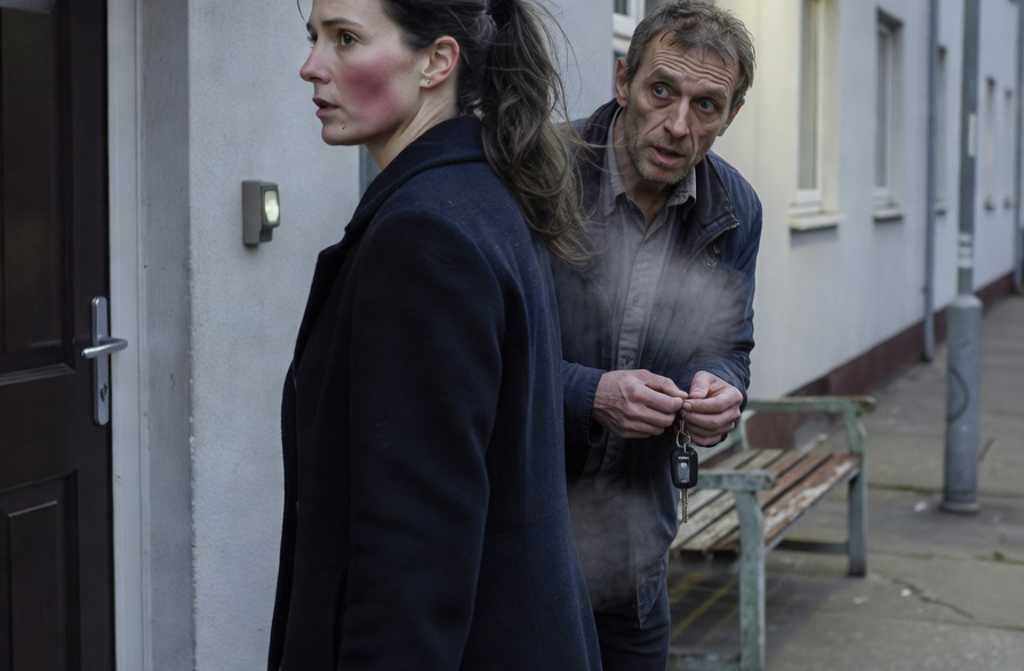
Sarah was standing right outside the entrance to her new place, you know? Just an ordinary block of flats in a quiet suburban neighbourhood, nothing special among all the others like it. She’d only just got back from work, and that bag of shopping was weighing on her arm, but it felt sort of comforting, reminding her of the simple home life she’d been wanting lately.
It was a chilly evening. Sarah shivered a bit, pulling her coat tighter around her. A light breeze was messing with the bits of hair that had slipped out of her messy ponytail, and her cheeks had a touch of pink from the cold. She was reaching for the buzzer when she spotted David.
He was standing a few steps away, like he couldn’t quite bring himself to come closer. He was nervously clutching his car keys that same silver keyring she’d picked out for him on his birthday once. His whole stance showed how on edge he was: shoulders all tight, fingers fiddling with the keys over and over, and his eyes darting across her face like he was trying to figure out her answer before she even said anything.
“Sarah, please just listen to me,” his voice came out softer than usual, almost shy. He took a tiny step forward but then stopped short, as if he was scared of startling her. “I’ve thought it all over. Let’s try again. I… I was wrong.”
Sarah let out a slow breath. She’d heard those words plenty of times before, at different points in their relationship, in different situations, but it always ended the same. Fancy talk followed by the same old ways, the same mistakes, more hurt. She looked at him steadily, without a bit of worry:
“David, we’ve talked about this already. I’m not coming back.”
He stepped nearer, almost right up to her. In his eyes there was this desperate hope, like he truly believed this time she’d change her mind.
“But look how it’s all gone!” his voice shook. “Without you… everything’s falling apart. I can’t handle it!”
Sarah just watched him in silence. The street lamp was softly lighting his face, and she saw for the first time how much he’d changed in the last six months. Deep lines had settled around his eyes that she’d never noticed before. His stubble, which used to be neatly trimmed, now looked unkempt, like he’d stopped caring about how he looked. And in his eyes was a tiredness she didn’t remember from all their fifteen years together.
David moved another step forward, almost crowding her space. His voice took on a pleading edge:
“Let’s start fresh. I’ll buy a flat. The one you wanted. And a car the one you dreamed about. Just come back…”
For a second Sarah felt something give inside. His voice sounded so real, his eyes burning with genuine want to make it right, that for a split second she almost believed him. But that feeling faded fast. She mentally ran through all those past promises big and shiny, but they stayed just words. How many times had he sworn he’d change, promised to begin again… And every time it went straight back to the old ways.
“No, David,” she said firmly. “I’ve made up my mind. And I’m sticking to it. You kicked me out yourself, you walked all over me… I’ll never forgive you.”
Sarah sighed quietly and set the bag of groceries down carefully on the wooden bench by the entrance. The evening air was getting cooler, and she pulled her coat tighter once more.
“You really don’t understand, do you, David?” her voice stayed calm, no irritation, but there was steel in it. “It’s not about the flat or the car.”
David started to open his mouth to argue, but Sarah gently lifted her hand, stopping him. He froze, swallowed hard and nodded silently, letting her know he was ready to hear her out.
“Remember how it all began?” her look went distant, like she was seeing not him but somewhere far back, into the past. Her eyes narrowed a little, as if trying to make out those old days through the haze of time.
She paused a moment to gather herself, then carried on:
“We were young and head over heels. You worked for a building firm, and I’d just started as a primary school teacher. We rented a flat small and cramped, but we were happy there. Money was tight, sometimes we had to count every penny till payday, but we didn’t let it drag us down. We’d cook dinners together, laugh at our little disasters, make plans for what was next. We dreamed of kids, pictured pushing a pram through the park, going as a family when term started…”
David nodded quietly. He really did remember that stretch one of the brightest times in his life. Back then everything felt possible. Any snag seemed like just a passing bump they’d sort together. He thought back to that first rented flat the tiny kitchen, the creaky sofa, the tap that dripped all the time and they never fixed before they left. Remembered sitting on the floor with pizza straight from the box, dreaming big and truly thinking it would all come good.
“Then the girls arrived,” Sarah’s voice warmed up, but there was a sad note creeping in. “First Emily, then five years later Chloe. You were over the moon, so proud of them. I remember you holding Emily in the hospital all worked up and beaming. And when Chloe was born, you got this massive bunch of roses and a cake, even though the doctors had been dead set against sweets…”
She smiled, but it came out sad, like thinking about those days both cheered her and stung.
“Then something shifted,” she went on, and her voice firmed up again. “You started bringing in more, bought this big flat in a new build, a car… Everything changed. You turned into the man of the house, the provider, the successful one. And I… I just became the wife who ‘does nothing’. Remember when you said once: ‘You sit at home while I’m running around like a headless chicken’? You didn’t even clock that behind that ‘sitting at home’ were nights up with poorly kids, school meetings, clubs, tutors, laundry, cleaning, cooking… All the stuff you didn’t count as proper work.”
Sarah stopped, looking at David. No anger in her eyes just weariness and quiet sadness from someone who’d spent ages trying to get something important across but never been heard.
David opened his mouth to push back the words were ready to tumble out in defence. But Sarah stopped him again with a hand. Her gaze was steady but set she wasn’t getting cut off today.
“Don’t interrupt, please,” she said again, raising her voice a touch so he’d be sure to catch it. “I kept quiet for too long, put up with it. You often said I was always moaning, kicking off over nothing. But do you know why it happened that way? Because I was trying to reach you. Trying to show that the girls needed more than just a new toy or a day out they needed attention, some discipline, clear lines. That love isn’t only about giving them what they fancy, but knowing when to say no when it’s right.”
She gave a short pause, letting it sink in a bit, then went on, speaking a little slower:
“You always let them have their way. Remember how Emily, when she was tiny, would run up to you with tears: ‘Daddy, I want a new tablet!’ and an hour later it was hers? Or how Chloe, when she was a bit older, would announce: ‘Daddy, I don’t want to do my homework!’ and you’d let her leave it till tomorrow because ‘the kid’s tired, needs a rest’?”
David looked down without meaning to. Those moments popped straight back clear as day. He could see the girls hugging his neck, whispering “You’re the best daddy!”, their faces lighting up at a new buy. Back then he thought he was spot on giving the kids a good time, making up for always being tied up at work. Sarah would frown and say something about proper raising, about what it might lead to, but he’d just wave it off: “Let them have fun while they’re small! Plenty of headaches coming later.”
“And when I tried to set them straight,” Sarah’s voice dropped but kept its edge, “you’d yell that I was ‘being mean to the kids’, that I was ‘horrible’. Remember how you told me off for raising my voice? Said it would mess with their heads, that I should be a ‘kind mum’ not some kind of strict one.”
She shook her head, and that shake showed not anger but deep tiredness from someone who’d tried explaining the same thing time after time without getting through.
“And this is what we got,” she continued, meeting his eyes straight on. “At eight and thirteen they don’t tidy up after themselves, they don’t know what no means, they don’t value a thing because they get it all the second they ask. They don’t see that you look after stuff, that time matters, that you own up to what you do. And when I try to lay down some rules, they dash to you: ‘Dad, Mum’s cross again!’ and you dive in, call me the bad guy.”
Sarah went quiet, giving him space to take it in. A heavy silence settled, only broken by far-off car sounds and the odd dog barking in the yard somewhere. She wasn’t waiting for a quick reply she just wanted him to finally see that her ‘always complaining’ wasn’t fussing but a last-ditch try to hold the family together, something he’d slowly undone.
David opened his mouth to argue, but the words seemed stuck. He wanted to say it wasn’t fair, that Sarah was making too much of it, that her take was too harsh. But as he started lining up his points in his head, he suddenly got it: deep down, she was right. Maybe not every last bit, but the core he really had done those things, thought those things, said those things.
“And then along came this Laura of yours,” Sarah went on, her voice flat, almost like she was talking about strangers. “Young, pretty, no kids, no ‘hassle’. She looked at you like you hung the moon, nodded at every word, never argued back. Always smiling, never brought up the daily grind, never nagged about school books or the fridge being bare.”
She paused a moment, letting each bit land, then carried on:
“And you decided that was it, the good life. That you’d finally found someone who ‘understood’ you. You came to me that evening once the girls were asleep. Spoke cold, like you were telling off someone at work: ‘Sarah, I can’t do this anymore. You’re always unhappy. All you do is shout, you don’t give me enough attention. I’ve met someone who gets me. Who just loves having me around’.”
David remembered every detail of that talk. Back then he’d felt almost heroic like someone who’d finally made a bold move, shaken off the weight of an ‘ungrateful’ family life. The idea in his head was: “I deserve to be happy.” He was even proud of how decisive he’d been, getting his gripes out clearly and not folding to any pleas. He thought he was being sensible, straight, adult about it.
“You said you wanted a divorce,” Sarah’s voice wobbled but she steadied herself quick, clenching her fists to hide it. “And you said the girls would stay with me. You came right out with it: ‘They’ll be better off with you. And I can finally live my own life’.”
She stopped for a beat, like going over that moment again, then added:
“You pictured seeing Laura, travelling, eating out, sorting yourself out. You even worked out how much child support you’d pay if the court left the kids with me. You’d planned the lot in advance the costs, the visiting times, possible deals. Like it was just another work contract, not our family.”
There was a quiet, worn-out bitterness in her voice from someone who’d tried so long to hold on to something that was already gone. She wasn’t blaming him for cheating, not yelling, not throwing jabs just laying out the things he’d once said, without a thought for how they sounded.
David swallowed, feeling a dry lump in his throat. Yes, he’d really thought that way then. Divorce had seemed not like a tough call but more like a way out a ticket to an easy new life. In his head it was all freedom: no daily worries, no nagging, no kids’ endless demands and household mess. Just space, rest, doing what he fancied, time with Laura, building something without the old baggage.
“I agreed to the divorce,” Sarah went on in a steady voice, like talking about something long over that didn’t stir her much anymore. “Not because I quit, and not because I stopped trying. Just at some point I saw it clear: you hadn’t been with me for ages. You were living your life, and I was living mine. We were like in separate worlds, where our paths didn’t meet anymore.”
She paused, picking her words, then added:
“And that’s when I said the girls would stay with you.”
David gave a little jolt, remembering that chat. At that moment he’d been speechless. He’d expected something totally different: free himself from family ties, start clean, live how he pleased. But her idea flipped everything upside down.
“You were shocked,” Sarah continued, looking him right in the eyes. “You shouted it was unfair, that I was ‘setting you up’, that I couldn’t do that. You didn’t get why I was pushing it. But I just wanted you to finally see: kids aren’t ‘in the way’ in life, not a drag, but part of it. And if you’d chosen to begin again, you had to learn to own up for the ones you’d brought into the world.”
He remembered that court day clearly. It all felt foggy: the judge’s stern face, the flat wording on the papers, the clerk’s flat voice. David had been dead certain it’d go his way. He’d already mapped out in his head how he’d start over, see Laura, travel, focus on himself. No doubts there just firm belief the court would cut him loose from ‘extra’ duties.
Then the judge read out the decision. The words came clear and cold: custody of the children to the father. For the first few seconds David didn’t even grasp it. He’d been braced for relief, for a lift but instead everything inside clenched. Instead of the freedom he’d waited for, he’d suddenly got two small ‘problems’ that were now all on him.
He thought back to that same evening, first time alone with the girls. The flat was strangely noisy, things all over, dinner had to be warmed from packets. And then it hit him: he couldn’t just head to work, come back whenever, brush off the little household bits. Now all that was down to him.
Sarah went quiet, giving him a moment.
“And that’s when you got what it was like raising two spoiled girls without their mum around,” Sarah said softly, no gloating in it. “You finally saw where your way of doing things had led. The girls wouldn’t listen, acted just like they’d learned… Only now there was no one to shove the issues onto.”
She paused a moment, like letting him drift back to those days in his head, then went on:
“Remember how you’d try to cook dinner but it all burned because you kept taking work calls? How the dishes piled up because neither you nor the girls had time to wash them? And one night you rang me in a panic because Chloe had a full meltdown over you not getting her new trainers ‘like the others’. You didn’t know what to do or how to calm her, so you just called my number…”
David closed his eyes. All those bits rushed past like scenes from a film he couldn’t pause. He saw himself in the kitchen with a burnt pan while Emily laughed and filmed it on her phone. Saw Chloe slamming her door, yelling he “didn’t get it”, while he stood in the hall not knowing what to do.
He tried laying down rules no screens till homework was done, a tidy-up rota, less pocket money. But after a day he’d fold at the tears and shouts: Emily would sob he was “cruel”, Chloe would threaten to go to her gran’s. He couldn’t take those scenes and gave in again.
And there was Laura. At first she played nice smiled at the girls, suggested park trips, bought them treats. But if Emily spilled juice on her new dress by accident or Chloe started acting up in a café, it all changed. Laura would pull back, pull a face at the mess, sigh when Chloe wanted attention. “I’m not ready for someone else’s kids,” she said one day, and it was only the beginning.
“Laura left after three months,” David said quietly, eyes still shut. The words came hard, like admitting something he was ashamed of. “Said she wasn’t ready for it. That it ‘wasn’t her thing’, that she wanted a different life easy, no bother, no responsibility.”
He stayed quiet a bit, sorting his thoughts, then added:
“And I… I suddenly saw that without you everything was crumbling. The girls don’t listen, the house is always a mess, work’s stressful because I’m shattered, distracted by their stuff. I thought I’d be free, that I’d finally live how I wanted. But I landed in a trap in a house where everything needs seeing to, where every day brings dozens of little questions I don’t have answers for.”
His voice cracked, but he pulled it together quick. No showing off or fishing for sympathy in what he said just a bitter knowing of how wrong he’d been, thinking family life was just a weight you could shake off easy.
Sarah looked at him with some sympathy, but no pity. No win in her eyes or wish to jab just calm understanding of what they’d both gone through.
“You know what’s the oddest bit?” she gave a small smile, and it had no bitterness or bite, just a light nod to how life twists. “When I was left on my own, I could finally breathe. Properly breathe, without that constant feeling of a huge weight on my shoulders.”
She went quiet a second, like going over those first weeks alone again, then carried on:
“I found a new job now I’m a senior advisor at an education centre. Not just a primary teacher, but someone who puts together programmes, helps other teachers, gets stuck into interesting projects. And you know what? I like it. I feel like I’m growing, that my know-how and experience really count. The pay’s better too enough for more than just the basics, enough to treat myself now and then.”
Sarah glanced around the yard where they stood, like seeing not just the grey buildings and playground but a snapshot of her new life.
“I’m renting this flat, and it’s fine. Covers everything: food, clothes, cinema trips at weekends. A manicure once a month, a book I’ve meant to read, a coffee in the nice café down the road. I don’t dash from work to the shop to grab bits for tomorrow’s dinner. Don’t cook endless three courses starter, main and pudding, like I’ve got a restaurant at home. Don’t tidy up after grown-ups who thought household stuff was only my job.”
Her voice stayed even, no challenge, just laying out facts that once felt like they couldn’t be got past.
“And something else big: I sleep through the night. Really sleep, not jumping up because someone’s got music on till three or decides to crack on with homework at midnight. I’m living, David. Just living calm, steady, without the constant strain and feeling I owe everyone something.”
She met his eyes straight and open, no hurt or blame. No wish to boast or show she was ahead just a quiet knowing that despite the rough bits, she’d found her path and felt truly happy.
David stayed silent. His head felt oddly empty no ready lines, no excuses, no usual ways to shield himself. He suddenly saw with sharp clarity: everything he’d wanted so much freedom, ease, admiration from a new girlfriend turned out to be just an illusion, a trick of the light. Real life, it turned out, had been there, in their old flat. In those very small things he’d got used to seeing as a drag: in her muttering about socks left lying, in endless patience, in quiet care he’d wrongly read as moaning and fault-finding.
He remembered how she’d brew him coffee in the mornings, even if she was late for work herself. How she’d quietly clear the dirty plates, even though he’d said he’d do it. How she always had the right words for the girls when he got stuck and cross. All that had seemed everyday, nothing much to him but now he saw plain: that was love. The real sort, that doesn’t make a fuss about itself but just is every day, in every little move, in every tiny thing.
“I’m asking you to come back not just because it’s really tough for me,” he said at last, and his voice was softer than before, without the old sureness. “But because I’ve seen: without you I can’t. I love you, Sarah.”
Those words didn’t come easy they seemed to push through layers of his old ideas, through walls of pride and overconfidence. He said it not to hold her, not from fear of being alone. He said it because for the first time in ages he’d looked honestly at himself and what he’d done.
Sarah looked at him a long while, not rushing an answer. She seemed to weigh each word, test if it was real, see if this was just another easy way out.
Then she silently picked up the bag of groceries from the bench and said quietly:
“I’m glad you’ve seen that. But I’m not coming back. I’m different now. And you… you need to be different too. Not for me for yourself. And for the girls. They need the real you, not a dad who’s just there handing out whatever they want.”
No hurt or irritation in her voice. It was a plain, clear statement no feelings layered on, no try to sting. She said what she thought, straight and without watching his reaction.
David wanted to argue, start persuading, bring up points but she’d already turned and headed to the entrance, not waiting.
“Sarah!” he called after her, not even sure what he meant to say.
She stopped, but didn’t turn.
“I’ll keep up with the child support, like before. And once a week time with the girls. It’ll be better for everyone.”
With that she went inside, leaving him alone under the cold November sky. The wind picked up, getting under his coat, but David barely felt it. He stood there, looking at the lit windows of her flat, where behind the curtains you could see the warm lamp glow.
Her words, the memories, the pictures spun in his head their life together, broken by his own hand. He remembered how they’d laughed at Emily’s first tricks, how they’d got Chloe ready for her first day at school, how they’d dreamed of what was ahead… All that now seemed so far off and so precious at once.
And then he understood it fully: he hadn’t just lost a wife. He’d lost the person who kept the family going, who could see past the quick wants and kept things on track for what really counted. The person who loved the real him not perfect, not without flaws, but just him.Sarah was standing right outside the entrance to her new place, you know? Just an ordinary block of flats in a quiet suburban neighbourhood, nothing special among all the others like it. She’d only just got back from work, and that bag of shopping was weighing on her arm, but it felt sort of comforting, reminding her of the simple home life she’d been wanting lately.
It was a chilly evening. Sarah shivered a bit, pulling her coat tighter around her. A light breeze was messing with the bits of hair that had slipped out of her messy ponytail, and her cheeks had a touch of pink from the cold. She was reaching for the buzzer when she spotted David.
He was standing a few steps away, like he couldn’t quite bring himself to come closer. He was nervously clutching his car keys that same silver keyring she’d picked out for him on his birthday once. His whole stance showed how on edge he was: shoulders all tight, fingers fiddling with the keys over and over, and his eyes darting across her face like he was trying to figure out her answer before she even said anything.
“Sarah, please just listen to me,” his voice came out softer than usual, almost shy. He took a tiny step forward but then stopped short, as if he was scared of startling her. “I’ve thought it all over. Let’s try again. I… I was wrong.”
Sarah let out a slow breath. She’d heard those words plenty of times before, at different points in their relationship, in different situations, but it always ended the same. Fancy talk followed by the same old ways, the same mistakes, more hurt. She looked at him steadily, without a bit of worry:
“David, we’ve talked about this already. I’m not coming back.”
He stepped nearer, almost right up to her. In his eyes there was this desperate hope, like he truly believed this time she’d change her mind.
“But look how it’s all gone!” his voice shook. “Without you… everything’s falling apart. I can’t handle it!”
Sarah just watched him in silence. The street lamp was softly lighting his face, and she saw for the first time how much he’d changed in the last six months. Deep lines had settled around his eyes that she’d never noticed before. His stubble, which used to be neatly trimmed, now looked unkempt, like he’d stopped caring about how he looked. And in his eyes was a tiredness she didn’t remember from all their fifteen years together.
David moved another step forward, almost crowding her space. His voice took on a pleading edge:
“Let’s start fresh. I’ll buy a flat. The one you wanted. And a car the one you dreamed about. Just come back…”
For a second Sarah felt something give inside. His voice sounded so real, his eyes burning with genuine want to make it right, that for a split second she almost believed him. But that feeling faded fast. She mentally ran through all those past promises big and shiny, but they stayed just words. How many times had he sworn he’d change, promised to begin again… And every time it went straight back to the old ways.
“No, David,” she said firmly. “I’ve made up my mind. And I’m sticking to it. You kicked me out yourself, you walked all over me… I’ll never forgive you.”
Sarah sighed quietly and set the bag of groceries down carefully on the wooden bench by the entrance. The evening air was getting cooler, and she pulled her coat tighter once more.
“You really don’t understand, do you, David?” her voice stayed calm, no irritation, but there was steel in it. “It’s not about the flat or the car.”
David started to open his mouth to argue, but Sarah gently lifted her hand, stopping him. He froze, swallowed hard and nodded silently, letting her know he was ready to hear her out.
“Remember how it all began?” her look went distant, like she was seeing not him but somewhere far back, into the past. Her eyes narrowed a little, as if trying to make out those old days through the haze of time.
She paused a moment to gather herself, then carried on:
“We were young and head over heels. You worked for a building firm, and I’d just started as a primary school teacher. We rented a flat small and cramped, but we were happy there. Money was tight, sometimes we had to count every penny till payday, but we didn’t let it drag us down. We’d cook dinners together, laugh at our little disasters, make plans for what was next. We dreamed of kids, pictured pushing a pram through the park, going as a family when term started…”
David nodded quietly. He really did remember that stretch one of the brightest times in his life. Back then everything felt possible. Any snag seemed like just a passing bump they’d sort together. He thought back to that first rented flat the tiny kitchen, the creaky sofa, the tap that dripped all the time and they never fixed before they left. Remembered sitting on the floor with pizza straight from the box, dreaming big and truly thinking it would all come good.
“Then the girls arrived,” Sarah’s voice warmed up, but there was a sad note creeping in. “First Emily, then five years later Chloe. You were over the moon, so proud of them. I remember you holding Emily in the hospital all worked up and beaming. And when Chloe was born, you got this massive bunch of roses and a cake, even though the doctors had been dead set against sweets…”
She smiled, but it came out sad, like thinking about those days both cheered her and stung.
“Then something shifted,” she went on, and her voice firmed up again. “You started bringing in more, bought this big flat in a new build, a car… Everything changed. You turned into the man of the house, the provider, the successful one. And I… I just became the wife who ‘does nothing’. Remember when you said once: ‘You sit at home while I’m running around like a headless chicken’? You didn’t even clock that behind that ‘sitting at home’ were nights up with poorly kids, school meetings, clubs, tutors, laundry, cleaning, cooking… All the stuff you didn’t count as proper work.”
Sarah stopped, looking at David. No anger in her eyes just weariness and quiet sadness from someone who’d spent ages trying to get something important across but never been heard.
David opened his mouth to push back the words were ready to tumble out in defence. But Sarah stopped him again with a hand. Her gaze was steady but set she wasn’t getting cut off today.
“Don’t interrupt, please,” she said again, raising her voice a touch so he’d be sure to catch it. “I kept quiet for too long, put up with it. You often said I was always moaning, kicking off over nothing. But do you know why it happened that way? Because I was trying to reach you. Trying to show that the girls needed more than just a new toy or a day out they needed attention, some discipline, clear lines. That love isn’t only about giving them what they fancy, but knowing when to say no when it’s right.”
She gave a short pause, letting it sink in a bit, then went on, speaking a little slower:
“You always let them have their way. Remember how Emily, when she was tiny, would run up to you with tears: ‘Daddy, I want a new tablet!’ and an hour later it was hers? Or how Chloe, when she was a bit older, would announce: ‘Daddy, I don’t want to do my homework!’ and you’d let her leave it till tomorrow because ‘the kid’s tired, needs a rest’?”
David looked down without meaning to. Those moments popped straight back clear as day. He could see the girls hugging his neck, whispering “You’re the best daddy!”, their faces lighting up at a new buy. Back then he thought he was spot on giving the kids a good time, making up for always being tied up at work. Sarah would frown and say something about proper raising, about what it might lead to, but he’d just wave it off: “Let them have fun while they’re small! Plenty of headaches coming later.”
“And when I tried to set them straight,” Sarah’s voice dropped but kept its edge, “you’d yell that I was ‘being mean to the kids’, that I was ‘horrible’. Remember how you told me off for raising my voice? Said it would mess with their heads, that I should be a ‘kind mum’ not some kind of strict one.”
She shook her head, and that shake showed not anger but deep tiredness from someone who’d tried explaining the same thing time after time without getting through.
“And this is what we got,” she continued, meeting his eyes straight on. “At eight and thirteen they don’t tidy up after themselves, they don’t know what no means, they don’t value a thing because they get it all the second they ask. They don’t see that you look after stuff, that time matters, that you own up to what you do. And when I try to lay down some rules, they dash to you: ‘Dad, Mum’s cross again!’ and you dive in, call me the bad guy.”
Sarah went quiet, giving him space to take it in. A heavy silence settled, only broken by far-off car sounds and the odd dog barking in the yard somewhere. She wasn’t waiting for a quick reply she just wanted him to finally see that her ‘always complaining’ wasn’t fussing but a last-ditch try to hold the family together, something he’d slowly undone.
David opened his mouth to argue, but the words seemed stuck. He wanted to say it wasn’t fair, that Sarah was making too much of it, that her take was too harsh. But as he started lining up his points in his head, he suddenly got it: deep down, she was right. Maybe not every last bit, but the core he really had done those things, thought those things, said those things.
“And then along came this Laura of yours,” Sarah went on, her voice flat, almost like she was talking about strangers. “Young, pretty, no kids, no ‘hassle’. She looked at you like you hung the moon, nodded at every word, never argued back. Always smiling, never brought up the daily grind, never nagged about school books or the fridge being bare.”
She paused a moment, letting each bit land, then carried on:
“And you decided that was it, the good life. That you’d finally found someone who ‘understood’ you. You came to me that evening once the girls were asleep. Spoke cold, like you were telling off someone at work: ‘Sarah, I can’t do this anymore. You’re always unhappy. All you do is shout, you don’t give me enough attention. I’ve met someone who gets me. Who just loves having me around’.”
David remembered every detail of that talk. Back then he’d felt almost heroic like someone who’d finally made a bold move, shaken off the weight of an ‘ungrateful’ family life. The idea in his head was: “I deserve to be happy.” He was even proud of how decisive he’d been, getting his gripes out clearly and not folding to any pleas. He thought he was being sensible, straight, adult about it.
“You said you wanted a divorce,” Sarah’s voice wobbled but she steadied herself quick, clenching her fists to hide it. “And you said the girls would stay with me. You came right out with it: ‘They’ll be better off with you. And I can finally live my own life’.”
She stopped for a beat, like going over that moment again, then added:
“You pictured seeing Laura, travelling, eating out, sorting yourself out. You even worked out how much child support you’d pay if the court left the kids with me. You’d planned the lot in advance the costs, the visiting times, possible deals. Like it was just another work contract, not our family.”
There was a quiet, worn-out bitterness in her voice from someone who’d tried so long to hold on to something that was already gone. She wasn’t blaming him for cheating, not yelling, not throwing jabs just laying out the things he’d once said, without a thought for how they sounded.
David swallowed, feeling a dry lump in his throat. Yes, he’d really thought that way then. Divorce had seemed not like a tough call but more like a way out a ticket to an easy new life. In his head it was all freedom: no daily worries, no nagging, no kids’ endless demands and household mess. Just space, rest, doing what he fancied, time with Laura, building something without the old baggage.
“I agreed to the divorce,” Sarah went on in a steady voice, like talking about something long over that didn’t stir her much anymore. “Not because I quit, and not because I stopped trying. Just at some point I saw it clear: you hadn’t been with me for ages. You were living your life, and I was living mine. We were like in separate worlds, where our paths didn’t meet anymore.”
She paused, picking her words, then added:
“And that’s when I said the girls would stay with you.”
David gave a little jolt, remembering that chat. At that moment he’d been speechless. He’d expected something totally different: free himself from family ties, start clean, live how he pleased. But her idea flipped everything upside down.
“You were shocked,” Sarah continued, looking him right in the eyes. “You shouted it was unfair, that I was ‘setting you up’, that I couldn’t do that. You didn’t get why I was pushing it. But I just wanted you to finally see: kids aren’t ‘in the way’ in life, not a drag, but part of it. And if you’d chosen to begin again, you had to learn to own up for the ones you’d brought into the world.”
He remembered that court day clearly. It all felt foggy: the judge’s stern face, the flat wording on the papers, the clerk’s flat voice. David had been dead certain it’d go his way. He’d already mapped out in his head how he’d start over, see Laura, travel, focus on himself. No doubts there just firm belief the court would cut him loose from ‘extra’ duties.
Then the judge read out the decision. The words came clear and cold: custody of the children to the father. For the first few seconds David didn’t even grasp it. He’d been braced for relief, for a lift but instead everything inside clenched. Instead of the freedom he’d waited for, he’d suddenly got two small ‘problems’ that were now all on him.
He thought back to that same evening, first time alone with the girls. The flat was strangely noisy, things all over, dinner had to be warmed from packets. And then it hit him: he couldn’t just head to work, come back whenever, brush off the little household bits. Now all that was down to him.
Sarah went quiet, giving him a moment.
“And that’s when you got what it was like raising two spoiled girls without their mum around,” Sarah said softly, no gloating in it. “You finally saw where your way of doing things had led. The girls wouldn’t listen, acted just like they’d learned… Only now there was no one to shove the issues onto.”
She paused a moment, like letting him drift back to those days in his head, then went on:
“Remember how you’d try to cook dinner but it all burned because you kept taking work calls? How the dishes piled up because neither you nor the girls had time to wash them? And one night you rang me in a panic because Chloe had a full meltdown over you not getting her new trainers ‘like the others’. You didn’t know what to do or how to calm her, so you just called my number…”
David closed his eyes. All those bits rushed past like scenes from a film he couldn’t pause. He saw himself in the kitchen with a burnt pan while Emily laughed and filmed it on her phone. Saw Chloe slamming her door, yelling he “didn’t get it”, while he stood in the hall not knowing what to do.
He tried laying down rules no screens till homework was done, a tidy-up rota, less pocket money. But after a day he’d fold at the tears and shouts: Emily would sob he was “cruel”, Chloe would threaten to go to her gran’s. He couldn’t take those scenes and gave in again.
And there was Laura. At first she played nice smiled at the girls, suggested park trips, bought them treats. But if Emily spilled juice on her new dress by accident or Chloe started acting up in a café, it all changed. Laura would pull back, pull a face at the mess, sigh when Chloe wanted attention. “I’m not ready for someone else’s kids,” she said one day, and it was only the beginning.
“Laura left after three months,” David said quietly, eyes still shut. The words came hard, like admitting something he was ashamed of. “Said she wasn’t ready for it. That it ‘wasn’t her thing’, that she wanted a different life easy, no bother, no responsibility.”
He stayed quiet a bit, sorting his thoughts, then added:
“And I… I suddenly saw that without you everything was crumbling. The girls don’t listen, the house is always a mess, work’s stressful because I’m shattered, distracted by their stuff. I thought I’d be free, that I’d finally live how I wanted. But I landed in a trap in a house where everything needs seeing to, where every day brings dozens of little questions I don’t have answers for.”
His voice cracked, but he pulled it together quick. No showing off or fishing for sympathy in what he said just a bitter knowing of how wrong he’d been, thinking family life was just a weight you could shake off easy.
Sarah looked at him with some sympathy, but no pity. No win in her eyes or wish to jab just calm understanding of what they’d both gone through.
“You know what’s the oddest bit?” she gave a small smile, and it had no bitterness or bite, just a light nod to how life twists. “When I was left on my own, I could finally breathe. Properly breathe, without that constant feeling of a huge weight on my shoulders.”
She went quiet a second, like going over those first weeks alone again, then carried on:
“I found a new job now I’m a senior advisor at an education centre. Not just a primary teacher, but someone who puts together programmes, helps other teachers, gets stuck into interesting projects. And you know what? I like it. I feel like I’m growing, that my know-how and experience really count. The pay’s better too enough for more than just the basics, enough to treat myself now and then.”
Sarah glanced around the yard where they stood, like seeing not just the grey buildings and playground but a snapshot of her new life.
“I’m renting this flat, and it’s fine. Covers everything: food, clothes, cinema trips at weekends. A manicure once a month, a book I’ve meant to read, a coffee in the nice café down the road. I don’t dash from work to the shop to grab bits for tomorrow’s dinner. Don’t cook endless three courses starter, main and pudding, like I’ve got a restaurant at home. Don’t tidy up after grown-ups who thought household stuff was only my job.”
Her voice stayed even, no challenge, just laying out facts that once felt like they couldn’t be got past.
“And something else big: I sleep through the night. Really sleep, not jumping up because someone’s got music on till three or decides to crack on with homework at midnight. I’m living, David. Just living calm, steady, without the constant strain and feeling I owe everyone something.”
She met his eyes straight and open, no hurt or blame. No wish to boast or show she was ahead just a quiet knowing that despite the rough bits, she’d found her path and felt truly happy.
David stayed silent. His head felt oddly empty no ready lines, no excuses, no usual ways to shield himself. He suddenly saw with sharp clarity: everything he’d wanted so much freedom, ease, admiration from a new girlfriend turned out to be just an illusion, a trick of the light. Real life, it turned out, had been there, in their old flat. In those very small things he’d got used to seeing as a drag: in her muttering about socks left lying, in endless patience, in quiet care he’d wrongly read as moaning and fault-finding.
He remembered how she’d brew him coffee in the mornings, even if she was late for work herself. How she’d quietly clear the dirty plates, even though he’d said he’d do it. How she always had the right words for the girls when he got stuck and cross. All that had seemed everyday, nothing much to him but now he saw plain: that was love. The real sort, that doesn’t make a fuss about itself but just is every day, in every little move, in every tiny thing.
“I’m asking you to come back not just because it’s really tough for me,” he said at last, and his voice was softer than before, without the old sureness. “But because I’ve seen: without you I can’t. I love you, Sarah.”
Those words didn’t come easy they seemed to push through layers of his old ideas, through walls of pride and overconfidence. He said it not to hold her, not from fear of being alone. He said it because for the first time in ages he’d looked honestly at himself and what he’d done.
Sarah looked at him a long while, not rushing an answer. She seemed to weigh each word, test if it was real, see if this was just another easy way out.
Then she silently picked up the bag of groceries from the bench and said quietly:
“I’m glad you’ve seen that. But I’m not coming back. I’m different now. And you… you need to be different too. Not for me for yourself. And for the girls. They need the real you, not a dad who’s just there handing out whatever they want.”
No hurt or irritation in her voice. It was a plain, clear statement no feelings layered on, no try to sting. She said what she thought, straight and without watching his reaction.
David wanted to argue, start persuading, bring up points but she’d already turned and headed to the entrance, not waiting.
“Sarah!” he called after her, not even sure what he meant to say.
She stopped, but didn’t turn.
“I’ll keep up with the child support, like before. And once a week time with the girls. It’ll be better for everyone.”
With that she went inside, leaving him alone under the cold November sky. The wind picked up, getting under his coat, but David barely felt it. He stood there, looking at the lit windows of her flat, where behind the curtains you could see the warm lamp glow.
Her words, the memories, the pictures spun in his head their life together, broken by his own hand. He remembered how they’d laughed at Emily’s first tricks, how they’d got Chloe ready for her first day at school, how they’d dreamed of what was ahead… All that now seemed so far off and so precious at once.
And then he understood it fully: he hadn’t just lost a wife. He’d lost the person who kept the family going, who could see past the quick wants and kept things on track for what really counted. The person who loved the real him not perfect, not without flaws, but just him.