
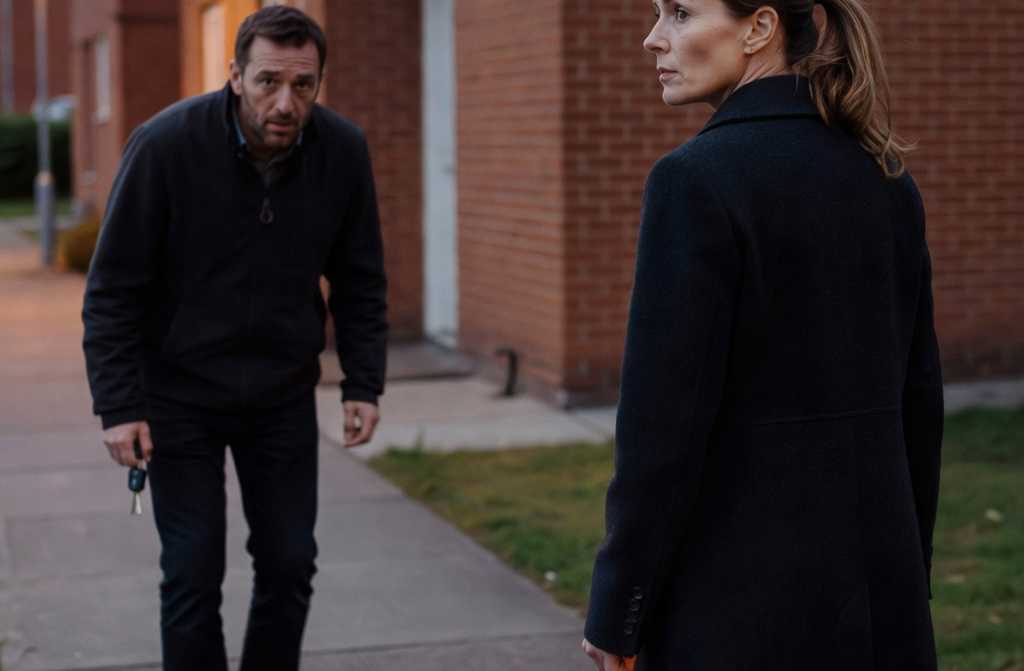
Sarah stood at the entrance to her new home, a plain red-brick block of flats that rose like a stack of identical dreams in a quiet suburban neighbourhood, unremarkable among rows of similar buildings. She had just returned from work, the bag of groceries tugging lightly at her arm like a reminder of simple comforts that flickered in and out of reach. The evening air folded around her in cool layers. She shivered, drawing her coat tighter. A faint breeze toyed with strands of hair escaping from a loose ponytail, brushing a soft flush across her cheeks. She reached for the intercom, which seemed to pulse under her fingers, when she noticed Michael.
He lingered a few paces off, as if the pavement between them had turned to slow-moving water he dared not cross. In his hands he clutched the car keys, the silver keychain she had once chosen for his birthday now glinting oddly in the lamplight. His shoulders were drawn tight, fingers sliding over the keys again and again, his gaze skimming her face like someone hunting for answers written in mist before any words formed.
Sarah, please listen, he said, his voice soft and uncertain in a way that did not belong to him. He took one hesitant step forward and stopped, as though afraid the moment might dissolve. I have thought it through. Let us try again. I was wrong.
Sarah breathed out slowly. The words drifted past her like ones she had heard before, in other rooms and other seasons, always ending the same. Behind the gentle phrases came the old patterns, the familiar slips, the fresh hurts. She met his eyes without a ripple of feeling. Michael, we have spoken of this. I am not coming back.
He moved nearer, almost close enough for his coat to brush hers. Desperate hope shone in his look, as if he believed this single instant could rewrite everything.
But see what has happened, his voice wavered. Without you everything falls apart. I cannot manage.
Sarah watched him in silence. The streetlamp cast a hazy glow over his face, and for the first time she saw clearly the shifts of the last six months. Deep lines had settled around his eyes. His stubble grew uneven, as though he had forgotten how to tend it. Fatigue sat in his gaze, heavier than any she recalled across fifteen years together.
He edged closer still, his voice taking on a pleading tone. Let us begin again. I will buy the flat you wanted. And the car you once spoke of. Only come back
For a heartbeat something stirred inside her, drawn by the sincerity in his tone and the raw light in his eyes. Then it faded. She turned over old promises in her mind, bright and loud yet never more than words. How often had he sworn change would come, only for everything to circle back.
No, Michael, she said firmly. My decision is made. You sent me away yourself and walked all over me. I will never forgive that.
She sighed and set the bag on the wooden bench beside the entrance. The air grew cooler still, so she wrapped her coat once more. You truly do not see, do you? she asked, calm but steady. It is not the flat or the car.
Michael opened his mouth, yet Sarah lifted a hand. He halted, swallowed, and gave a small nod.
Remember how we began? Her eyes drifted, as though peering through layers of fog at days long gone. She paused, then went on. We were young and in love. You worked at a building company. I had only just started teaching primary classes. We rented a small flat, cramped but enough. Money stretched thin; we counted pennies until payday, yet we kept going. We cooked together, laughed at our mistakes, and planned ahead. We dreamed of children, of pushing a pram through the park, of walking as a family on the first day of term.
Michael nodded. That time remained one of the clearest in his memory. Every difficulty had felt like something they could share and pass through. He recalled the tiny kitchen, the creaking sofa, the tap that dripped without end. He saw them sitting on the floor, eating pizza from a box, certain the future would unfold as they wished.
Then the girls arrived, Sarah said, her voice warming yet edged with sorrow. Emily first, then Olivia five years later. You were so proud. I remember you holding Emily in the hospital, eyes bright with wonder. When Olivia came you brought roses and a cake, even though the doctors had forbidden sweets.
She smiled, though the expression carried both comfort and ache.
After that something shifted, she continued, voice firming. You earned more, bought the larger flat in the new development and the car. You became the provider, the man in charge. I became simply the wife who does nothing. You once said, You sit at home while I run around like a hamster on a wheel. You never noticed the sleepless nights with ill children, the school meetings, the clubs, the laundry, the meals. All the work you claimed did not count.
She fell quiet, studying him. No anger lived in her eyes, only weariness and a quiet sadness from years of trying to explain what went unheard.
Michael started to speak, yet Sarah raised her hand again. Her look held calm resolve; she would not be stopped.
Do not interrupt, she said, voice rising slightly. I stayed silent too long. You said I was always unhappy, that I created scenes from nothing. It happened because I kept trying to reach you. I wanted you to understand the girls needed more than toys or seaside trips. They needed attention, boundaries, the ability to hear no when it mattered.
She paused, letting the words settle. You gave them everything. Emily would run to you crying for a new tablet and receive it within the hour. Olivia would refuse homework and you would allow her to wait until tomorrow because she was tired. I tried to set rules and you called me cruel. You told me raising my voice harmed them, that I must be the kind mother, never the one who said no.
She shook her head, the motion heavy with fatigue rather than rage.
This is the outcome, she said, meeting his gaze. At eight and thirteen they leave things where they fall, they do not understand limits, they value nothing because they receive it at once. They do not learn to care for what they have or to answer for what they do. When I try to hold any line they run to you saying I am angry, and you defend them.
Silence stretched, broken only by distant cars and a dog barking somewhere beyond the buildings. She waited for him to take it in, not for agreement but for understanding that her complaints had been an attempt to hold the family steady before it tipped.
Michael tried to answer, yet the words lodged. He wanted to claim she saw it wrongly, yet as he searched for reasons he found only the truth she had spoken.
Then Amelia appeared, Sarah went on, her tone flat, as if recounting a tale that belonged to strangers. Young, without children or the weight of daily life. She nodded at everything, smiled always, never mentioned schoolbooks or an empty fridge.
She let the pause linger. You decided this was what you wanted. You came to me one evening after the girls slept and spoke as if addressing someone beneath you: Sarah, I cannot continue. You are never satisfied. You shout and give me no attention. I have found someone who understands me, who is glad simply that I exist.
Michael recalled every detail. He had felt bold then, freed from an ungrateful burden. The thought that he deserved ease had seemed right and adult.
You asked for the divorce, Sarah said, voice catching before she steadied it by clenching her hands. You said the girls would stay with me, that they would be better off and you could live freely. You pictured travels and restaurants with Amelia. You even worked out the child support in advance, as though arranging a business matter.
Her words carried tired bitterness, not accusation, only the plain record of what he had once said.
Michael swallowed against the dryness in his throat. Yes, he had believed divorce would bring release, no more complaints or small demands, only freedom.
I agreed, Sarah continued evenly. Not because I surrendered, but because I saw you had already left. We moved in separate worlds. Then I told you the girls would stay with you.
Michael flinched at the memory. He had expected relief, not this reversal.
You were shocked, she said. You shouted it was unfair, that I was trapping you. You did not grasp why I insisted. I wanted you to learn that children are not obstacles but the life you chose, and that starting over meant carrying the responsibility you helped create.
He remembered the court as if through gauze: the judges face, the papers, the clerks steady voice. He had been certain the children would remain with Sarah. Instead custody passed to him. What he had awaited as freedom became two small lives now fully his.
That first evening alone the flat felt loud and disordered. Ready meals replaced proper cooking. He realised he could no longer ignore the small tasks. Sarah waited, letting him feel the weight.
You learned what it meant to raise two spoiled girls without help, she said quietly, without triumph. They would not listen. There was no one else to blame.
She paused again. You tried to cook and the food burned while you answered work calls. Dishes piled up. One night you rang me in panic because Olivia had screamed over new trainers you had not bought. You did not know how to quiet her.
Michael closed his eyes. The scenes returned unbidden: the scorched pan, Emily filming him with her phone, Olivia slamming doors while he stood helpless in the hallway. He had set rules about homework and chores, yet tears and threats made him yield within a day.
Amelia had smiled at first, offered park walks and sweets. When juice stained her dress or Olivia fussed in public she stepped back, sighed at the mess, and finally said she was not ready for anothers children.
Amelia left after three months, Michael murmured, eyes still shut. She said it was not the life she wanted, not light enough, not free of responsibility.
He drew breath. Without you everything crumbled. The girls ignored me. The house stayed in chaos. Work suffered because I was tired and distracted. I had imagined freedom. Instead I faced questions I could not answer, every single day.
His voice shook then steadied. The admission held no plea, only the clear taste of his mistake in thinking family was a weight one could simply drop.
Sarah regarded him with understanding but no pity. No victory lived in her look, only recognition of the path they had both walked.
Do you know the strangest part? she said, a small smile touching her mouth without bitterness. When I was alone I could finally breathe. Truly breathe, without the sense that something too heavy rested on me.
She paused, recalling those first weeks that had felt both empty and open. I found work as a senior educational consultant at a learning centre. Not only teaching primary classes, but shaping programmes and supporting other teachers. It suits me. My pay is higher, enough for what is needed and for small pleasures.
Her gaze moved across the yard, seeing beyond the buildings to the life that had taken shape. I rent this flat and manage. There is food, clothes, cinema on weekends, a manicure now and then, a book, coffee in a nearby café. I no longer hurry from work to buy tomorrows dinner. I do not prepare three courses as though running a restaurant at home. I do not tidy after adults who believed household tasks belonged only to me.
Her voice stayed level, simply naming what had once seemed impossible. And I sleep through the night. No one plays music until three or starts homework at midnight. I live, Michael. Calmly, without the constant feeling that I owe everyone something.
She met his eyes openly. Her words carried no boast, only the quiet fact that she had found her way and felt content.
Michael stood without ready answers. His mind held nothing familiar to defend with. He saw at last that the freedom he had chased had been a mirage. The real life had been in the old flat, in the daily acts he had called burdens: her quiet clearing of plates, her morning coffee even when rushed, her steady words for the girls when he had none. These had been love, ordinary and constant.
I ask you to return not only because I am struggling, he said at last, voice low and stripped of old certainty. I ask because I see now that without you I cannot manage. I love you, Sarah.
The words came hard, breaking through years of pride. He spoke them because he had finally looked at what he had done.
Sarah studied him without hurry, weighing each syllable for truth. Then she lifted the bag from the bench.
I am glad you understand, she said quietly. But I will not return. I am different now. You must become different too, for yourself and for the girls. They need the real you, not a father who grants every wish.
No anger coloured her tone, only clear statement. She turned and walked toward the entrance.
Sarah! he called, uncertain what more to say.
She paused but did not look back. I will pay the child support as before. Once a week you may see the girls. It will be better for everyone.
She stepped inside, leaving him beneath the cold November sky. The wind rose, yet he barely noticed. He remained, watching the lit windows where a lamp glowed behind curtains. Her words and the fragments of their shared years turned in his mind: laughter over Emilys early mischief, preparing Olivia for her first term, plans once held close. All of it now felt distant yet precious.
He understood at last that he had lost more than a wife. He had lost the person who kept the home steady, who saw past passing wants and held to what mattered. The person who had loved him as he was, simply him.Sarah stood at the entrance to her new home, a plain red-brick block of flats that rose like a stack of identical dreams in a quiet suburban neighbourhood, unremarkable among rows of similar buildings. She had just returned from work, the bag of groceries tugging lightly at her arm like a reminder of simple comforts that flickered in and out of reach. The evening air folded around her in cool layers. She shivered, drawing her coat tighter. A faint breeze toyed with strands of hair escaping from a loose ponytail, brushing a soft flush across her cheeks. She reached for the intercom, which seemed to pulse under her fingers, when she noticed Michael.
He lingered a few paces off, as if the pavement between them had turned to slow-moving water he dared not cross. In his hands he clutched the car keys, the silver keychain she had once chosen for his birthday now glinting oddly in the lamplight. His shoulders were drawn tight, fingers sliding over the keys again and again, his gaze skimming her face like someone hunting for answers written in mist before any words formed.
Sarah, please listen, he said, his voice soft and uncertain in a way that did not belong to him. He took one hesitant step forward and stopped, as though afraid the moment might dissolve. I have thought it through. Let us try again. I was wrong.
Sarah breathed out slowly. The words drifted past her like ones she had heard before, in other rooms and other seasons, always ending the same. Behind the gentle phrases came the old patterns, the familiar slips, the fresh hurts. She met his eyes without a ripple of feeling. Michael, we have spoken of this. I am not coming back.
He moved nearer, almost close enough for his coat to brush hers. Desperate hope shone in his look, as if he believed this single instant could rewrite everything.
But see what has happened, his voice wavered. Without you everything falls apart. I cannot manage.
Sarah watched him in silence. The streetlamp cast a hazy glow over his face, and for the first time she saw clearly the shifts of the last six months. Deep lines had settled around his eyes. His stubble grew uneven, as though he had forgotten how to tend it. Fatigue sat in his gaze, heavier than any she recalled across fifteen years together.
He edged closer still, his voice taking on a pleading tone. Let us begin again. I will buy the flat you wanted. And the car you once spoke of. Only come back
For a heartbeat something stirred inside her, drawn by the sincerity in his tone and the raw light in his eyes. Then it faded. She turned over old promises in her mind, bright and loud yet never more than words. How often had he sworn change would come, only for everything to circle back.
No, Michael, she said firmly. My decision is made. You sent me away yourself and walked all over me. I will never forgive that.
She sighed and set the bag on the wooden bench beside the entrance. The air grew cooler still, so she wrapped her coat once more. You truly do not see, do you? she asked, calm but steady. It is not the flat or the car.
Michael opened his mouth, yet Sarah lifted a hand. He halted, swallowed, and gave a small nod.
Remember how we began? Her eyes drifted, as though peering through layers of fog at days long gone. She paused, then went on. We were young and in love. You worked at a building company. I had only just started teaching primary classes. We rented a small flat, cramped but enough. Money stretched thin; we counted pennies until payday, yet we kept going. We cooked together, laughed at our mistakes, and planned ahead. We dreamed of children, of pushing a pram through the park, of walking as a family on the first day of term.
Michael nodded. That time remained one of the clearest in his memory. Every difficulty had felt like something they could share and pass through. He recalled the tiny kitchen, the creaking sofa, the tap that dripped without end. He saw them sitting on the floor, eating pizza from a box, certain the future would unfold as they wished.
Then the girls arrived, Sarah said, her voice warming yet edged with sorrow. Emily first, then Olivia five years later. You were so proud. I remember you holding Emily in the hospital, eyes bright with wonder. When Olivia came you brought roses and a cake, even though the doctors had forbidden sweets.
She smiled, though the expression carried both comfort and ache.
After that something shifted, she continued, voice firming. You earned more, bought the larger flat in the new development and the car. You became the provider, the man in charge. I became simply the wife who does nothing. You once said, You sit at home while I run around like a hamster on a wheel. You never noticed the sleepless nights with ill children, the school meetings, the clubs, the laundry, the meals. All the work you claimed did not count.
She fell quiet, studying him. No anger lived in her eyes, only weariness and a quiet sadness from years of trying to explain what went unheard.
Michael started to speak, yet Sarah raised her hand again. Her look held calm resolve; she would not be stopped.
Do not interrupt, she said, voice rising slightly. I stayed silent too long. You said I was always unhappy, that I created scenes from nothing. It happened because I kept trying to reach you. I wanted you to understand the girls needed more than toys or seaside trips. They needed attention, boundaries, the ability to hear no when it mattered.
She paused, letting the words settle. You gave them everything. Emily would run to you crying for a new tablet and receive it within the hour. Olivia would refuse homework and you would allow her to wait until tomorrow because she was tired. I tried to set rules and you called me cruel. You told me raising my voice harmed them, that I must be the kind mother, never the one who said no.
She shook her head, the motion heavy with fatigue rather than rage.
This is the outcome, she said, meeting his gaze. At eight and thirteen they leave things where they fall, they do not understand limits, they value nothing because they receive it at once. They do not learn to care for what they have or to answer for what they do. When I try to hold any line they run to you saying I am angry, and you defend them.
Silence stretched, broken only by distant cars and a dog barking somewhere beyond the buildings. She waited for him to take it in, not for agreement but for understanding that her complaints had been an attempt to hold the family steady before it tipped.
Michael tried to answer, yet the words lodged. He wanted to claim she saw it wrongly, yet as he searched for reasons he found only the truth she had spoken.
Then Amelia appeared, Sarah went on, her tone flat, as if recounting a tale that belonged to strangers. Young, without children or the weight of daily life. She nodded at everything, smiled always, never mentioned schoolbooks or an empty fridge.
She let the pause linger. You decided this was what you wanted. You came to me one evening after the girls slept and spoke as if addressing someone beneath you: Sarah, I cannot continue. You are never satisfied. You shout and give me no attention. I have found someone who understands me, who is glad simply that I exist.
Michael recalled every detail. He had felt bold then, freed from an ungrateful burden. The thought that he deserved ease had seemed right and adult.
You asked for the divorce, Sarah said, voice catching before she steadied it by clenching her hands. You said the girls would stay with me, that they would be better off and you could live freely. You pictured travels and restaurants with Amelia. You even worked out the child support in advance, as though arranging a business matter.
Her words carried tired bitterness, not accusation, only the plain record of what he had once said.
Michael swallowed against the dryness in his throat. Yes, he had believed divorce would bring release, no more complaints or small demands, only freedom.
I agreed, Sarah continued evenly. Not because I surrendered, but because I saw you had already left. We moved in separate worlds. Then I told you the girls would stay with you.
Michael flinched at the memory. He had expected relief, not this reversal.
You were shocked, she said. You shouted it was unfair, that I was trapping you. You did not grasp why I insisted. I wanted you to learn that children are not obstacles but the life you chose, and that starting over meant carrying the responsibility you helped create.
He remembered the court as if through gauze: the judges face, the papers, the clerks steady voice. He had been certain the children would remain with Sarah. Instead custody passed to him. What he had awaited as freedom became two small lives now fully his.
That first evening alone the flat felt loud and disordered. Ready meals replaced proper cooking. He realised he could no longer ignore the small tasks. Sarah waited, letting him feel the weight.
You learned what it meant to raise two spoiled girls without help, she said quietly, without triumph. They would not listen. There was no one else to blame.
She paused again. You tried to cook and the food burned while you answered work calls. Dishes piled up. One night you rang me in panic because Olivia had screamed over new trainers you had not bought. You did not know how to quiet her.
Michael closed his eyes. The scenes returned unbidden: the scorched pan, Emily filming him with her phone, Olivia slamming doors while he stood helpless in the hallway. He had set rules about homework and chores, yet tears and threats made him yield within a day.
Amelia had smiled at first, offered park walks and sweets. When juice stained her dress or Olivia fussed in public she stepped back, sighed at the mess, and finally said she was not ready for anothers children.
Amelia left after three months, Michael murmured, eyes still shut. She said it was not the life she wanted, not light enough, not free of responsibility.
He drew breath. Without you everything crumbled. The girls ignored me. The house stayed in chaos. Work suffered because I was tired and distracted. I had imagined freedom. Instead I faced questions I could not answer, every single day.
His voice shook then steadied. The admission held no plea, only the clear taste of his mistake in thinking family was a weight one could simply drop.
Sarah regarded him with understanding but no pity. No victory lived in her look, only recognition of the path they had both walked.
Do you know the strangest part? she said, a small smile touching her mouth without bitterness. When I was alone I could finally breathe. Truly breathe, without the sense that something too heavy rested on me.
She paused, recalling those first weeks that had felt both empty and open. I found work as a senior educational consultant at a learning centre. Not only teaching primary classes, but shaping programmes and supporting other teachers. It suits me. My pay is higher, enough for what is needed and for small pleasures.
Her gaze moved across the yard, seeing beyond the buildings to the life that had taken shape. I rent this flat and manage. There is food, clothes, cinema on weekends, a manicure now and then, a book, coffee in a nearby café. I no longer hurry from work to buy tomorrows dinner. I do not prepare three courses as though running a restaurant at home. I do not tidy after adults who believed household tasks belonged only to me.
Her voice stayed level, simply naming what had once seemed impossible. And I sleep through the night. No one plays music until three or starts homework at midnight. I live, Michael. Calmly, without the constant feeling that I owe everyone something.
She met his eyes openly. Her words carried no boast, only the quiet fact that she had found her way and felt content.
Michael stood without ready answers. His mind held nothing familiar to defend with. He saw at last that the freedom he had chased had been a mirage. The real life had been in the old flat, in the daily acts he had called burdens: her quiet clearing of plates, her morning coffee even when rushed, her steady words for the girls when he had none. These had been love, ordinary and constant.
I ask you to return not only because I am struggling, he said at last, voice low and stripped of old certainty. I ask because I see now that without you I cannot manage. I love you, Sarah.
The words came hard, breaking through years of pride. He spoke them because he had finally looked at what he had done.
Sarah studied him without hurry, weighing each syllable for truth. Then she lifted the bag from the bench.
I am glad you understand, she said quietly. But I will not return. I am different now. You must become different too, for yourself and for the girls. They need the real you, not a father who grants every wish.
No anger coloured her tone, only clear statement. She turned and walked toward the entrance.
Sarah! he called, uncertain what more to say.
She paused but did not look back. I will pay the child support as before. Once a week you may see the girls. It will be better for everyone.
She stepped inside, leaving him beneath the cold November sky. The wind rose, yet he barely noticed. He remained, watching the lit windows where a lamp glowed behind curtains. Her words and the fragments of their shared years turned in his mind: laughter over Emilys early mischief, preparing Olivia for her first term, plans once held close. All of it now felt distant yet precious.
He understood at last that he had lost more than a wife. He had lost the person who kept the home steady, who saw past passing wants and held to what mattered. The person who had loved him as he was, simply him.