
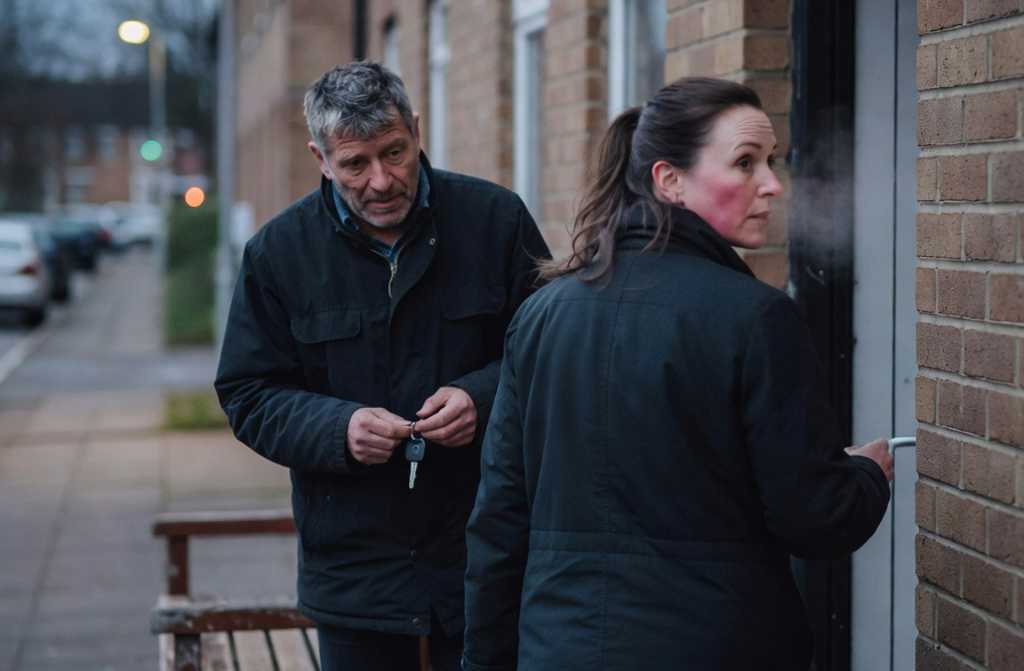
Claire stood outside the entrance to her new block of flats. It was one of those unremarkable brick buildings in a residential suburb, blending in with all the others like a row of identical biscuits in a packet. She’d just got back from work, and the shopping bag was weighing down her arm, a reminder of the simple home comforts she’d been craving lately.
The evening was a bit nippy. Claire shivered, pulling her coat tighter around her. A gentle breeze played with the strands of hair that had escaped her messy ponytail, and her cheeks had a faint flush from the cold. She was reaching for the buzzer when she spotted Mark.
He was standing a few paces away, as if he couldn’t quite pluck up the courage to come closer. His hands were fidgeting with his car keys the same silver fob she’d picked out for him on his birthday years ago. His posture screamed nerves: shoulders hunched, fingers twisting the keys, eyes darting over her face like he was trying to guess her reaction before she said a word.
“Claire, please just listen,” his voice came out softer than usual, almost hesitant. He took a tiny step forward then stopped, like he was afraid of startling her. “I’ve thought about everything. Let’s give it another go. I… I was wrong.”
Claire let out a slow breath. She’d heard variations of this before at different stages of their marriage, under different roofs, but the ending was always the same. Pretty words followed by the same old habits, the same mistakes, fresh hurts. She looked at him steadily, no hint of excitement:
“Mark, we’ve been through this. I’m not coming back.”
He moved closer, almost too close. His eyes held a desperate sort of hope, as if he genuinely thought this time would be different.
“But look how it’s all turned out!” His voice cracked a little. “Without you… it’s all falling apart. I can’t handle it!”
Claire watched him quietly. The street lamp cast a soft glow on his face, and for the first time she really noticed the changes from the past six months. Deep lines had settled around his eyes that she hadn’t seen before. His stubble, once neatly trimmed, looked scruffy now, like he’d forgotten to bother with his appearance. And in his eyes was a weariness she didn’t remember from their fifteen years together.
Mark took another step, invading her personal space. A pleading tone crept into his voice:
“Let’s start over. I’ll buy a flat. The one you wanted. And a car the kind you used to talk about. Just come back…”
For a split second, Claire felt something stir inside. His voice had that ring of sincerity, his eyes burning with a real desire to fix things, and for a moment she almost wanted to believe. But it passed quickly. She mentally flipped through the parade of past promises grand, shiny, but always just talk. How many times had he sworn to change, to begin anew… and every time it circled back to the same old story.
“No, Mark,” she said firmly. “I’ve made my decision, and I’m sticking to it. You were the one who pushed me out, who treated me like I didn’t matter. I’ll never forgive that.”
Claire sighed softly and carefully set the shopping bag down on the wooden bench by the entrance. The evening air was getting chillier, so she wrapped her coat even tighter.
“Do you really not get it, Mark?” Her voice was calm, no anger, but steady as a rock. “It’s not about the flat or the car.”
Mark opened his mouth to argue, but Claire gently raised her hand to stop him. He froze, swallowed, and nodded silently, showing he was ready to listen.
“Remember how it all started?” Her gaze drifted, like she was looking past him into the past. Her eyes narrowed slightly, as if trying to make out those old days through the fog of time.
She paused for a moment to gather her thoughts, then went on:
“We were young and head over heels. You were working at that construction company, and I’d just landed my first job as a primary school teacher. We rented this tiny flat cramped, with a dodgy tap that dripped all night, but we made it work. Money was tight; we were counting every penny until payday, but we didn’t let it get us down. We’d cook together, laugh at our kitchen disasters, and dream about what came next. Kids, family walks in the park with a pram, the whole crew heading off for the first day of term…”
Mark nodded without a word. He did remember that time one of the brightest bits in his life. Back then, every hurdle seemed like something they could tackle as a team. He thought of their first rented place: the minuscule kitchen, the squeaky sofa, that leaky tap they never got round to fixing before moving. Sitting on the floor eating takeaway pizza from the box, planning a future they truly believed in.
“Then the girls came along,” Claire’s voice warmed up, though a touch of sadness slipped in. “Emily first, and five years later Sophie. You were over the moon, so proud. I remember you holding Emily in the hospital, looking like you’d just won the lottery. When Sophie arrived, you brought the biggest bunch of roses and a cake, even though the doctors had banned anything sweet for me…”
She smiled, but it was a bittersweet one, the kind that remembers good times while knowing they’re gone.
“But then things shifted,” she continued, her tone firming up again. “You started earning more, bought this big new flat, got the car… Everything changed. Suddenly you were the head of the household, the breadwinner, the successful one. And I… I was just the wife who ‘did nothing’. Remember when you said, ‘You lounge about at home while I’m spinning like a top at work’? You didn’t see that ‘lounging’ meant nights up with poorly kids, parents’ evenings, after-school clubs, extra lessons, washing, hoovering, meals on the table. All that stuff you didn’t count as proper work.”
Claire fell silent, watching Mark. There was no anger in her eyes, just exhaustion and a quiet sadness from someone who’d tried to explain something important and kept being ignored.
Mark started to speak, words queuing up to defend himself. But Claire stopped him again with a hand. Her look was steady, determined she wasn’t going to be cut off today.
“Please don’t interrupt,” she said, raising her voice a notch so he couldn’t miss it. “I stayed quiet for too long, put up with it. You kept telling me I was never happy, that I kicked up a fuss over nothing. But do you know why? Because I was trying to get through to you. Trying to say the girls needed more than just new toys or a holiday they needed attention, some structure, boundaries. Love isn’t just giving them everything they want; it’s knowing when to say no, even if it’s hard.”
She took a short breath, letting that sink in, then continued more slowly:
“You always gave in to them. Remember Emily, barely tall enough to reach the table, running up with tears in her eyes: ‘Daddy, I want a new tablet!’ and an hour later it was hers? Or Sophie, a bit older, declaring ‘Daddy, I don’t want to do my homework!’ and you’d let her put it off because ‘she’s tired, she needs a break’?”
Mark’s head dropped a little. Those moments flashed back vividly. The girls hugging his neck, calling him the best dad, their faces lighting up at the new stuff. At the time it felt right giving them treats to make up for being away so much at work. Claire would frown, talk about boundaries, but he’d brush it off: “Let them enjoy it while they’re young! Plenty of time for rules later.”
“And when I tried to bring in some discipline,” Claire’s voice dropped but stayed strong, “you’d say I was ‘picking on the kids’, that I was ‘too strict’. Remember how you told me off for raising my voice? Said it would mess with their heads, that I should be the ‘nice mum’, not the ‘enforcer’.”
She shook her head, the motion full of tired resignation rather than fury.
“And here’s the result,” she said, meeting his eyes. “At eight and thirteen, they leave their stuff everywhere, don’t understand the word ‘no’, and don’t appreciate a thing because they’ve never had to wait for it. They don’t know how to look after their belongings or that time matters or that actions have consequences. And when I try to lay down some ground rules, they run straight to you: ‘Dad, Mum’s being mean again!’ and you jump in, calling me the bad guy.”
Claire paused, letting the words hang in the air. The only sounds were distant traffic and the occasional bark from a dog in the yard. She wasn’t expecting an instant reply just wanted him to finally see that her “constant nagging” had been a last-ditch effort to keep the family balanced, something he’d slowly undone without noticing.
Mark opened his mouth, but the words stuck. He wanted to argue it was all exaggerated, that her view was too black and white. But as he ran through his defences in his head, he realised: deep down, she was right. Not every detail, maybe, but the core of it yes, that was how he’d behaved.
“Then there was Rachel,” Claire went on, her voice even, almost like she was narrating someone else’s tale. “Young, pretty, no kids, no ‘hassles’. She looked at you like you hung the moon, agreed with everything, never argued. Always smiling, never mentioning the school run or the fact the fridge was nearly empty.”
She gave him a moment, then carried on:
“And you decided that was happiness. That you’d finally found someone who ‘got’ you. You came to me that evening after the girls were in bed. Spoke like you were sacking an employee: ‘Claire, I can’t do this anymore. You’re always complaining. You never give me any attention. I’ve met someone who understands me. Who just likes me for being me.'”
Mark remembered every bit of that chat. He’d felt like some kind of hero finally making the brave move, shedding the weight of an “ungrateful” family life. The thought had looped: “I deserve to be happy.” He’d even been a bit proud of his clarity, laying out his grievances without letting emotions sway him. It seemed mature, fair, adult.
“You said you wanted a divorce,” Claire’s voice wavered for a second, but she clenched her fists and steadied herself. “And that the girls would stay with me. You came right out with it: ‘They’ll be better off with you. I can finally live my own life.'”
She stopped briefly, reliving it, then added:
“You pictured meeting up with Rachel, going on trips, dinners out, looking after yourself. You even worked out how much child support you’d pay if the court left the girls with me. All calculated in advance costs, schedules, possible deals. Like it was a business transaction, not our family.”
There was a weary bitterness in her tone, the kind from someone who’d fought hard to hold onto something that was already slipping away. She wasn’t accusing him of betrayal or shouting; she was just laying out the facts he’d once stated so casually.
Mark swallowed, feeling a dry lump in his throat. Yes, that was exactly how he’d seen it then. The divorce had seemed like a golden ticket to an easier existence no more daily grind, no more complaints, no more kids’ dramas and household chores. In his mind, it was freedom, rest, time for what he wanted, with Rachel, building something new without the old baggage.
“I agreed to the divorce,” Claire continued in a steady voice, as if talking about something that had happened to someone else long ago. “Not because I’d given up or stopped caring. But because I realised you’d already checked out. You were living your life, I was living mine. We’d ended up in different worlds, and our paths weren’t crossing anymore.”
She paused to find the right words.
“So I told you the girls would stay with you.”
Mark flinched, recalling the moment. He’d been speechless. He’d expected the opposite: shed the responsibilities, start fresh, do as he pleased. Her suggestion had flipped everything upside down.
“You were stunned,” Claire said, looking straight at him. “You shouted it was unfair, that I was ‘setting you up’, that I couldn’t do that. You didn’t understand why I was pushing it. But I just wanted you to finally see: kids aren’t obstacles or burdens they’re part of the deal. If you were choosing a new start, you had to own the responsibility for bringing them into it.”
He remembered the court day clearly. It all felt hazy: the judge’s stern face, the dry legal speak, the clerk’s monotone. Mark had been certain the decision would go his way. He’d already mapped out the new life, the time with Rachel, the travel, the self-care. No room for doubt just confidence the court would free him from the “extra” duties.
Then the judge announced it. The words were crisp and cool: custody to the father. For the first few seconds, Mark didn’t even register. He’d braced for relief instead, his stomach dropped. Instead of the freedom he’d craved, he’d landed two small “issues” that were now entirely his problem.
He thought back to that first evening alone with the girls. The flat was oddly loud, stuff scattered about, dinner reheated from frozen. It hit him then: he couldn’t just head to work and come back whenever, ignoring the little things. All of it was on him now.
Claire gave him a moment.
“And that’s when you got what it was like raising two spoilt girls without backup,” she said quietly, no malice. “You finally saw where your way of doing things had led. The girls wouldn’t listen to you, acted like they always had… but now there was no one else to blame.”
She paused again.
“Remember trying to cook and everything burning because you kept answering work calls? Dishes piling up because neither you nor the girls had time? One night you rang me in a panic because Sophie was in tears over not getting the new trainers ‘like everyone else’. You didn’t know how to calm her down, so you called me…”
Mark closed his eyes. The scenes played out like a bad movie he couldn’t pause. The burnt pan in the kitchen while Emily filmed it laughing. Sophie slamming her door, yelling he “didn’t get it”, him standing there clueless.
He’d tried setting rules no screens until homework done, a cleaning rota, limited pocket money. But within a day the tears and shouts wore him down: Emily sobbing he was “horrible”, Sophie threatening to go to grandma’s. He’d cave every time.
And Rachel. At first she played nice smiled at the girls, suggested park trips, bought sweets. But when Emily spilled juice on her new dress or Sophie acted up in a restaurant, the mask slipped. Rachel would step back, wrinkle her nose at the mess, sigh when Sophie demanded attention. “I’m not cut out for someone else’s kids,” she’d said once, and that was the start.
“Rachel left after three months,” Mark said softly, eyes still shut. The words came hard, like admitting a fault. “Said she wasn’t ready for it. That it ‘wasn’t her story’, she wanted an easy life no fuss, no duties.”
He stopped, thinking, then added:
“And I… I realised everything was crumbling without you. The girls ignored me, the house was a mess, work was hell because I was knackered and distracted by their dramas. I thought I’d be free, finally able to live how I wanted. Instead I was trapped in a place where everything needed sorting, and every day brought a dozen tiny problems with no answers.”
His voice shook, but he pulled it together. This wasn’t for sympathy or show just a raw admission of how wrong he’d been, thinking family life was just a weight you could drop.
Claire looked at him with understanding, but not pity. No triumph, no jab just a calm recognition of what they’d both been through.
“Know what’s the funniest part?” she said with a small smile, pure gentle irony, no bitterness. “When I was on my own, I could finally breathe. Really breathe, without that constant weight on my shoulders.”
She paused, remembering those early weeks of independence.
“I got a new job senior education advisor at a learning centre now. Not just teaching little ones, but creating programmes, supporting other teachers, joining in on interesting projects. And I actually like it. I feel like I’m growing, that my skills count for something. The pay’s better too covers the basics and leaves room for little treats.”
Claire glanced around the courtyard, seeing not just the grey buildings and playground, but the shape of her fresh start.
“I rent this flat, and it’s comfortable enough. Covers food, clothes, cinema trips at weekends. A manicure once a month, that book I’ve been meaning to read, a nice coffee nearby. I don’t have to dash to the shops straight after work to grab dinner ingredients. No more whipping up three courses like I’m feeding a small army. No tidying up after grown adults who thought housework was someone else’s job.”
Her voice was even, just stating how things were now, things that once felt impossible.
“And the best bit: I sleep at night. Properly sleep, without waking to music blasting at 3am or someone deciding midnight is homework o’clock. I’m living, Mark. Just living calmly, steadily, without the constant stress and feeling like I owe everyone something.”
She met his eyes openly, no resentment. She wasn’t boasting or proving a point just sharing that, despite everything, she’d found her footing and felt genuinely content.
Mark was quiet. His mind felt strangely blank no ready comebacks, no excuses, no usual shields. He saw with sudden clarity: everything he’d chased so hard freedom, ease, the adoration of a new partner had been a mirage. The real life had been right there in their old flat. In the small things he’d seen as burdens: her muttering about socks on the floor, her endless patience, the quiet care he’d mistaken for grumbling.
He remembered her making his coffee in the mornings even when she was running late. Clearing the table quietly when he’d promised to do it. Knowing just what to say to the girls when he was at a loss and cross. It had all seemed routine but now he saw it was love. The real kind, that doesn’t announce itself but just shows up every day, in every small act.
“I’m asking you to come back not just because it’s so bloody hard without you,” he said at last, his voice unusually quiet, stripped of its old confidence. “But because I get it now: I can’t manage without you. I love you, Claire.”
The words didn’t come easy they pushed through layers of old beliefs, pride, and stubbornness. He wasn’t saying it to keep her or out of fear of being alone. He said it because for the first time in ages he’d looked honestly at himself and what he’d done.
Claire watched him for a long time, not rushing. She weighed each word, tested its honesty, wondered if this was just another easy fix.
Then she silently picked up the shopping bag from the bench and said quietly:
“I’m glad you’ve realised. But I’m not coming back. I’m different now. And you… you need to become different too. Not for me for yourself. And for the girls. They need the real you, not just a dad who hands out treats on demand.”
No anger or irritation in her voice. Just a plain, clear statement no frills, no attempt to hurt. She said what she thought, straight up.
Mark wanted to argue, to persuade, to list reasons but she was already turning and heading for the entrance, not waiting.
“Claire!” he called after her, not sure what else to say.
She stopped but didn’t turn around.
“I’ll keep up with the child support like before. And weekly visits with the girls. It’s better for everyone this way.”
With that, she went inside, leaving him alone under the cold November sky. The wind picked up, sneaking under his coat, but Mark barely noticed the chill. He stood there, staring at the lit windows of her flat, where warm lamp light peeked through the curtains.
Her words, the memories, the images swirled in his head their shared life, shattered by his own choices. He thought of laughing at Emily’s first silly antics, getting Sophie ready for her first day at school, dreaming about what lay ahead… It all felt so distant now, and so precious.
And then it hit him fully: he hadn’t just lost a wife. He’d lost the person who kept the home fires burning, who could see past the quick wins and steered towards what really counted. The one who loved the real him not perfect, not flawless, just him.Claire stood outside the entrance to her new block of flats. It was one of those unremarkable brick buildings in a residential suburb, blending in with all the others like a row of identical biscuits in a packet. She’d just got back from work, and the shopping bag was weighing down her arm, a reminder of the simple home comforts she’d been craving lately.
The evening was a bit nippy. Claire shivered, pulling her coat tighter around her. A gentle breeze played with the strands of hair that had escaped her messy ponytail, and her cheeks had a faint flush from the cold. She was reaching for the buzzer when she spotted Mark.
He was standing a few paces away, as if he couldn’t quite pluck up the courage to come closer. His hands were fidgeting with his car keys the same silver fob she’d picked out for him on his birthday years ago. His posture screamed nerves: shoulders hunched, fingers twisting the keys, eyes darting over her face like he was trying to guess her reaction before she said a word.
“Claire, please just listen,” his voice came out softer than usual, almost hesitant. He took a tiny step forward then stopped, like he was afraid of startling her. “I’ve thought about everything. Let’s give it another go. I… I was wrong.”
Claire let out a slow breath. She’d heard variations of this before at different stages of their marriage, under different roofs, but the ending was always the same. Pretty words followed by the same old habits, the same mistakes, fresh hurts. She looked at him steadily, no hint of excitement:
“Mark, we’ve been through this. I’m not coming back.”
He moved closer, almost too close. His eyes held a desperate sort of hope, as if he genuinely thought this time would be different.
“But look how it’s all turned out!” His voice cracked a little. “Without you… it’s all falling apart. I can’t handle it!”
Claire watched him quietly. The street lamp cast a soft glow on his face, and for the first time she really noticed the changes from the past six months. Deep lines had settled around his eyes that she hadn’t seen before. His stubble, once neatly trimmed, looked scruffy now, like he’d forgotten to bother with his appearance. And in his eyes was a weariness she didn’t remember from their fifteen years together.
Mark took another step, invading her personal space. A pleading tone crept into his voice:
“Let’s start over. I’ll buy a flat. The one you wanted. And a car the kind you used to talk about. Just come back…”
For a split second, Claire felt something stir inside. His voice had that ring of sincerity, his eyes burning with a real desire to fix things, and for a moment she almost wanted to believe. But it passed quickly. She mentally flipped through the parade of past promises grand, shiny, but always just talk. How many times had he sworn to change, to begin anew… and every time it circled back to the same old story.
“No, Mark,” she said firmly. “I’ve made my decision, and I’m sticking to it. You were the one who pushed me out, who treated me like I didn’t matter. I’ll never forgive that.”
Claire sighed softly and carefully set the shopping bag down on the wooden bench by the entrance. The evening air was getting chillier, so she wrapped her coat even tighter.
“Do you really not get it, Mark?” Her voice was calm, no anger, but steady as a rock. “It’s not about the flat or the car.”
Mark opened his mouth to argue, but Claire gently raised her hand to stop him. He froze, swallowed, and nodded silently, showing he was ready to listen.
“Remember how it all started?” Her gaze drifted, like she was looking past him into the past. Her eyes narrowed slightly, as if trying to make out those old days through the fog of time.
She paused for a moment to gather her thoughts, then went on:
“We were young and head over heels. You were working at that construction company, and I’d just landed my first job as a primary school teacher. We rented this tiny flat cramped, with a dodgy tap that dripped all night, but we made it work. Money was tight; we were counting every penny until payday, but we didn’t let it get us down. We’d cook together, laugh at our kitchen disasters, and dream about what came next. Kids, family walks in the park with a pram, the whole crew heading off for the first day of term…”
Mark nodded without a word. He did remember that time one of the brightest bits in his life. Back then, every hurdle seemed like something they could tackle as a team. He thought of their first rented place: the minuscule kitchen, the squeaky sofa, that leaky tap they never got round to fixing before moving. Sitting on the floor eating takeaway pizza from the box, planning a future they truly believed in.
“Then the girls came along,” Claire’s voice warmed up, though a touch of sadness slipped in. “Emily first, and five years later Sophie. You were over the moon, so proud. I remember you holding Emily in the hospital, looking like you’d just won the lottery. When Sophie arrived, you brought the biggest bunch of roses and a cake, even though the doctors had banned anything sweet for me…”
She smiled, but it was a bittersweet one, the kind that remembers good times while knowing they’re gone.
“But then things shifted,” she continued, her tone firming up again. “You started earning more, bought this big new flat, got the car… Everything changed. Suddenly you were the head of the household, the breadwinner, the successful one. And I… I was just the wife who ‘did nothing’. Remember when you said, ‘You lounge about at home while I’m spinning like a top at work’? You didn’t see that ‘lounging’ meant nights up with poorly kids, parents’ evenings, after-school clubs, extra lessons, washing, hoovering, meals on the table. All that stuff you didn’t count as proper work.”
Claire fell silent, watching Mark. There was no anger in her eyes, just exhaustion and a quiet sadness from someone who’d tried to explain something important and kept being ignored.
Mark started to speak, words queuing up to defend himself. But Claire stopped him again with a hand. Her look was steady, determined she wasn’t going to be cut off today.
“Please don’t interrupt,” she said, raising her voice a notch so he couldn’t miss it. “I stayed quiet for too long, put up with it. You kept telling me I was never happy, that I kicked up a fuss over nothing. But do you know why? Because I was trying to get through to you. Trying to say the girls needed more than just new toys or a holiday they needed attention, some structure, boundaries. Love isn’t just giving them everything they want; it’s knowing when to say no, even if it’s hard.”
She took a short breath, letting that sink in, then continued more slowly:
“You always gave in to them. Remember Emily, barely tall enough to reach the table, running up with tears in her eyes: ‘Daddy, I want a new tablet!’ and an hour later it was hers? Or Sophie, a bit older, declaring ‘Daddy, I don’t want to do my homework!’ and you’d let her put it off because ‘she’s tired, she needs a break’?”
Mark’s head dropped a little. Those moments flashed back vividly. The girls hugging his neck, calling him the best dad, their faces lighting up at the new stuff. At the time it felt right giving them treats to make up for being away so much at work. Claire would frown, talk about boundaries, but he’d brush it off: “Let them enjoy it while they’re young! Plenty of time for rules later.”
“And when I tried to bring in some discipline,” Claire’s voice dropped but stayed strong, “you’d say I was ‘picking on the kids’, that I was ‘too strict’. Remember how you told me off for raising my voice? Said it would mess with their heads, that I should be the ‘nice mum’, not the ‘enforcer’.”
She shook her head, the motion full of tired resignation rather than fury.
“And here’s the result,” she said, meeting his eyes. “At eight and thirteen, they leave their stuff everywhere, don’t understand the word ‘no’, and don’t appreciate a thing because they’ve never had to wait for it. They don’t know how to look after their belongings or that time matters or that actions have consequences. And when I try to lay down some ground rules, they run straight to you: ‘Dad, Mum’s being mean again!’ and you jump in, calling me the bad guy.”
Claire paused, letting the words hang in the air. The only sounds were distant traffic and the occasional bark from a dog in the yard. She wasn’t expecting an instant reply just wanted him to finally see that her “constant nagging” had been a last-ditch effort to keep the family balanced, something he’d slowly undone without noticing.
Mark opened his mouth, but the words stuck. He wanted to argue it was all exaggerated, that her view was too black and white. But as he ran through his defences in his head, he realised: deep down, she was right. Not every detail, maybe, but the core of it yes, that was how he’d behaved.
“Then there was Rachel,” Claire went on, her voice even, almost like she was narrating someone else’s tale. “Young, pretty, no kids, no ‘hassles’. She looked at you like you hung the moon, agreed with everything, never argued. Always smiling, never mentioning the school run or the fact the fridge was nearly empty.”
She gave him a moment, then carried on:
“And you decided that was happiness. That you’d finally found someone who ‘got’ you. You came to me that evening after the girls were in bed. Spoke like you were sacking an employee: ‘Claire, I can’t do this anymore. You’re always complaining. You never give me any attention. I’ve met someone who understands me. Who just likes me for being me.'”
Mark remembered every bit of that chat. He’d felt like some kind of hero finally making the brave move, shedding the weight of an “ungrateful” family life. The thought had looped: “I deserve to be happy.” He’d even been a bit proud of his clarity, laying out his grievances without letting emotions sway him. It seemed mature, fair, adult.
“You said you wanted a divorce,” Claire’s voice wavered for a second, but she clenched her fists and steadied herself. “And that the girls would stay with me. You came right out with it: ‘They’ll be better off with you. I can finally live my own life.'”
She stopped briefly, reliving it, then added:
“You pictured meeting up with Rachel, going on trips, dinners out, looking after yourself. You even worked out how much child support you’d pay if the court left the girls with me. All calculated in advance costs, schedules, possible deals. Like it was a business transaction, not our family.”
There was a weary bitterness in her tone, the kind from someone who’d fought hard to hold onto something that was already slipping away. She wasn’t accusing him of betrayal or shouting; she was just laying out the facts he’d once stated so casually.
Mark swallowed, feeling a dry lump in his throat. Yes, that was exactly how he’d seen it then. The divorce had seemed like a golden ticket to an easier existence no more daily grind, no more complaints, no more kids’ dramas and household chores. In his mind, it was freedom, rest, time for what he wanted, with Rachel, building something new without the old baggage.
“I agreed to the divorce,” Claire continued in a steady voice, as if talking about something that had happened to someone else long ago. “Not because I’d given up or stopped caring. But because I realised you’d already checked out. You were living your life, I was living mine. We’d ended up in different worlds, and our paths weren’t crossing anymore.”
She paused to find the right words.
“So I told you the girls would stay with you.”
Mark flinched, recalling the moment. He’d been speechless. He’d expected the opposite: shed the responsibilities, start fresh, do as he pleased. Her suggestion had flipped everything upside down.
“You were stunned,” Claire said, looking straight at him. “You shouted it was unfair, that I was ‘setting you up’, that I couldn’t do that. You didn’t understand why I was pushing it. But I just wanted you to finally see: kids aren’t obstacles or burdens they’re part of the deal. If you were choosing a new start, you had to own the responsibility for bringing them into it.”
He remembered the court day clearly. It all felt hazy: the judge’s stern face, the dry legal speak, the clerk’s monotone. Mark had been certain the decision would go his way. He’d already mapped out the new life, the time with Rachel, the travel, the self-care. No room for doubt just confidence the court would free him from the “extra” duties.
Then the judge announced it. The words were crisp and cool: custody to the father. For the first few seconds, Mark didn’t even register. He’d braced for relief instead, his stomach dropped. Instead of the freedom he’d craved, he’d landed two small “issues” that were now entirely his problem.
He thought back to that first evening alone with the girls. The flat was oddly loud, stuff scattered about, dinner reheated from frozen. It hit him then: he couldn’t just head to work and come back whenever, ignoring the little things. All of it was on him now.
Claire gave him a moment.
“And that’s when you got what it was like raising two spoilt girls without backup,” she said quietly, no malice. “You finally saw where your way of doing things had led. The girls wouldn’t listen to you, acted like they always had… but now there was no one else to blame.”
She paused again.
“Remember trying to cook and everything burning because you kept answering work calls? Dishes piling up because neither you nor the girls had time? One night you rang me in a panic because Sophie was in tears over not getting the new trainers ‘like everyone else’. You didn’t know how to calm her down, so you called me…”
Mark closed his eyes. The scenes played out like a bad movie he couldn’t pause. The burnt pan in the kitchen while Emily filmed it laughing. Sophie slamming her door, yelling he “didn’t get it”, him standing there clueless.
He’d tried setting rules no screens until homework done, a cleaning rota, limited pocket money. But within a day the tears and shouts wore him down: Emily sobbing he was “horrible”, Sophie threatening to go to grandma’s. He’d cave every time.
And Rachel. At first she played nice smiled at the girls, suggested park trips, bought sweets. But when Emily spilled juice on her new dress or Sophie acted up in a restaurant, the mask slipped. Rachel would step back, wrinkle her nose at the mess, sigh when Sophie demanded attention. “I’m not cut out for someone else’s kids,” she’d said once, and that was the start.
“Rachel left after three months,” Mark said softly, eyes still shut. The words came hard, like admitting a fault. “Said she wasn’t ready for it. That it ‘wasn’t her story’, she wanted an easy life no fuss, no duties.”
He stopped, thinking, then added:
“And I… I realised everything was crumbling without you. The girls ignored me, the house was a mess, work was hell because I was knackered and distracted by their dramas. I thought I’d be free, finally able to live how I wanted. Instead I was trapped in a place where everything needed sorting, and every day brought a dozen tiny problems with no answers.”
His voice shook, but he pulled it together. This wasn’t for sympathy or show just a raw admission of how wrong he’d been, thinking family life was just a weight you could drop.
Claire looked at him with understanding, but not pity. No triumph, no jab just a calm recognition of what they’d both been through.
“Know what’s the funniest part?” she said with a small smile, pure gentle irony, no bitterness. “When I was on my own, I could finally breathe. Really breathe, without that constant weight on my shoulders.”
She paused, remembering those early weeks of independence.
“I got a new job senior education advisor at a learning centre now. Not just teaching little ones, but creating programmes, supporting other teachers, joining in on interesting projects. And I actually like it. I feel like I’m growing, that my skills count for something. The pay’s better too covers the basics and leaves room for little treats.”
Claire glanced around the courtyard, seeing not just the grey buildings and playground, but the shape of her fresh start.
“I rent this flat, and it’s comfortable enough. Covers food, clothes, cinema trips at weekends. A manicure once a month, that book I’ve been meaning to read, a nice coffee nearby. I don’t have to dash to the shops straight after work to grab dinner ingredients. No more whipping up three courses like I’m feeding a small army. No tidying up after grown adults who thought housework was someone else’s job.”
Her voice was even, just stating how things were now, things that once felt impossible.
“And the best bit: I sleep at night. Properly sleep, without waking to music blasting at 3am or someone deciding midnight is homework o’clock. I’m living, Mark. Just living calmly, steadily, without the constant stress and feeling like I owe everyone something.”
She met his eyes openly, no resentment. She wasn’t boasting or proving a point just sharing that, despite everything, she’d found her footing and felt genuinely content.
Mark was quiet. His mind felt strangely blank no ready comebacks, no excuses, no usual shields. He saw with sudden clarity: everything he’d chased so hard freedom, ease, the adoration of a new partner had been a mirage. The real life had been right there in their old flat. In the small things he’d seen as burdens: her muttering about socks on the floor, her endless patience, the quiet care he’d mistaken for grumbling.
He remembered her making his coffee in the mornings even when she was running late. Clearing the table quietly when he’d promised to do it. Knowing just what to say to the girls when he was at a loss and cross. It had all seemed routine but now he saw it was love. The real kind, that doesn’t announce itself but just shows up every day, in every small act.
“I’m asking you to come back not just because it’s so bloody hard without you,” he said at last, his voice unusually quiet, stripped of its old confidence. “But because I get it now: I can’t manage without you. I love you, Claire.”
The words didn’t come easy they pushed through layers of old beliefs, pride, and stubbornness. He wasn’t saying it to keep her or out of fear of being alone. He said it because for the first time in ages he’d looked honestly at himself and what he’d done.
Claire watched him for a long time, not rushing. She weighed each word, tested its honesty, wondered if this was just another easy fix.
Then she silently picked up the shopping bag from the bench and said quietly:
“I’m glad you’ve realised. But I’m not coming back. I’m different now. And you… you need to become different too. Not for me for yourself. And for the girls. They need the real you, not just a dad who hands out treats on demand.”
No anger or irritation in her voice. Just a plain, clear statement no frills, no attempt to hurt. She said what she thought, straight up.
Mark wanted to argue, to persuade, to list reasons but she was already turning and heading for the entrance, not waiting.
“Claire!” he called after her, not sure what else to say.
She stopped but didn’t turn around.
“I’ll keep up with the child support like before. And weekly visits with the girls. It’s better for everyone this way.”
With that, she went inside, leaving him alone under the cold November sky. The wind picked up, sneaking under his coat, but Mark barely noticed the chill. He stood there, staring at the lit windows of her flat, where warm lamp light peeked through the curtains.
Her words, the memories, the images swirled in his head their shared life, shattered by his own choices. He thought of laughing at Emily’s first silly antics, getting Sophie ready for her first day at school, dreaming about what lay ahead… It all felt so distant now, and so precious.
And then it hit him fully: he hadn’t just lost a wife. He’d lost the person who kept the home fires burning, who could see past the quick wins and steered towards what really counted. The one who loved the real him not perfect, not flawless, just him.